Boutique on a Budget
Small Luthiers That Are Undercutting the Big Two
Gear Deep Dive
You walk into a Guitar Center. On the wall: a new American Professional II Stratocaster at $1,599. Next to it, a Gibson Les Paul Standard at $2,799. You ask about the Custom Shop. The rep smiles. “Depends what you want,” he says. “Usually starts around $4,000. Lead time is about 12 to 18 months.”
You go home and start Googling. Somewhere around page three, you find a forum thread from a working guitarist who paid $3,200 for something called a Kauer Daylighter. He says it’s the best guitar he’s ever owned. The fret work was perfect out of the box. The setup didn’t need touching. It arrived in 10 weeks. He’s gigged it 200 nights since.
Most players skim past that and go back to looking at Gibsons. That’s a mistake.
Gibson and Fender have raised prices every year since 2022. Their entry-level lines, Squier and Epiphone, now run $500 to $1,500. Their production American instruments sit at $1,500 to $2,800. Custom Shop work starts at $4,000 and goes up from there. And at every tier, the complaint you hear most is the same: quality control is all over the map. Two Les Paul Standards off the same rack, different neck feels, different fret work, different weight. You’re rolling dice at $2,800.
Meanwhile, a dozen small builders across the country are making 300 to 750 guitars a year, setting them up by hand, and shipping them in 8 to 14 weeks. Players who own them say the same thing. The guitar was right when it arrived. Not pretty good. Right.
This article is about who those builders are, what you get from them, and why more players are choosing them over the Big Two.
The Big Two Have a Problem
The pandemic created a buying surge that guitar companies chased hard. Fender overproduced so aggressively in 2022 that they ended up holding $100 million in canceled orders. Costs went up globally: materials, shipping, labor. The price increases hit every tier and never came back down.
The result is a market where “affordable” costs $1,000 and “premium production” costs $2,800. Quality control on production instruments has not improved proportionally. Players and techs who work on these guitars regularly describe Gibson’s QC as inconsistent at best. Fender is more stable but still a production line: no one at the factory is losing sleep over your specific guitar.
When you spend $3,000 on a guitar and need to pay a tech $150 to set it up properly, the value proposition starts to look different.
What Boutique Builders Are Actually Doing
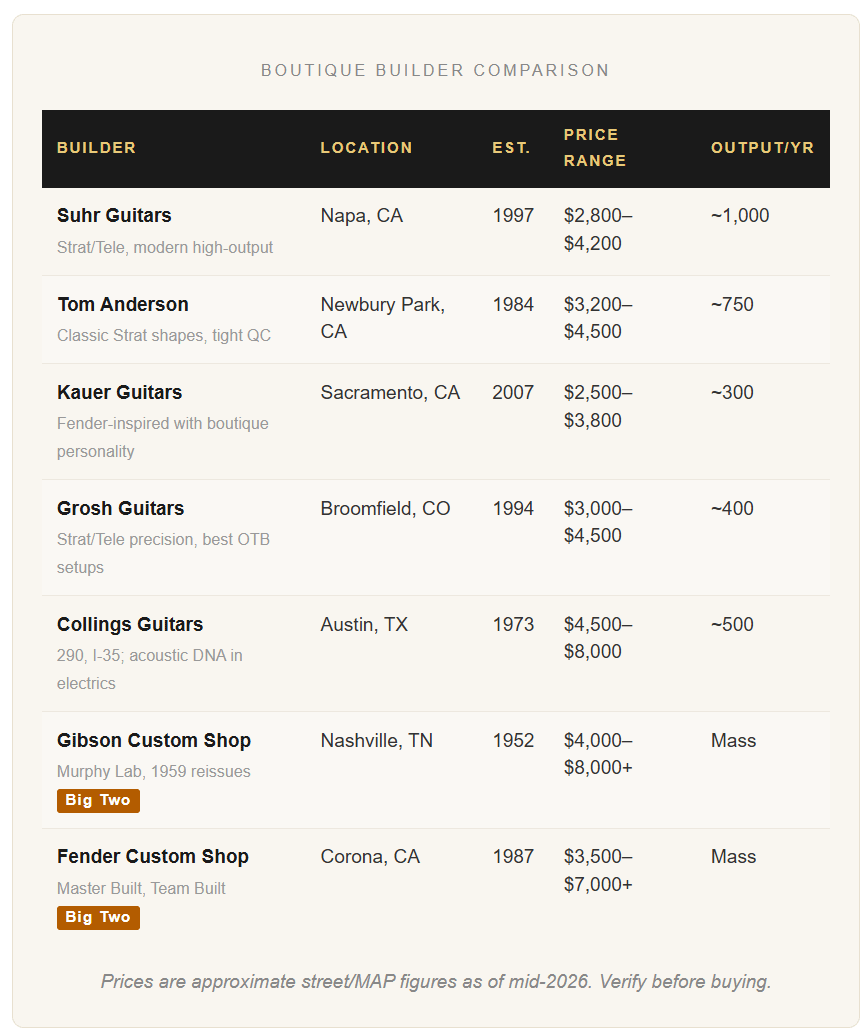
Suhr (Napa, CA): John Suhr built guitars for Fender’s Custom Shop before going independent in 1997. Players consistently report that every Suhr they’ve picked up was set up correctly out of the box, fret work done to a standard that production Fenders do not hit. Modern Classics run $2,800 to $4,200.
Tom Anderson Guitarworks (Newbury Park, CA): Anderson makes around 750 guitars a year and has since 1984. No bankruptcy, no hype cycle. Players who’ve played multiple Andersons use one word: great. Not great for the price. Just great. Classics run $3,200 to $4,500.
Kauer Guitars (Sacramento, CA): Doug Kauer started in 2007. His artist roster includes Scott Holiday of Rival Sons, Brad Whitford of Aerosmith, and Tom Dumont of No Doubt. His instruments take Fender shapes and add something stranger: Guyatone weirdness, Teisco character, a feel you don’t get from a production guitar. Daylighters and Starliners run $2,500 to $3,800.
Collings Guitars (Austin, TX): Built its name on acoustics, makes electrics that players consistently rank above comparable Gibsons on playability and build. The 290 and I-35 get described as “a few steps beyond PRS.” Semi-hollows now run $7,000 to $8,000, so this is not the budget end of boutique. But at that price, players say it beats a Gibson ES-335 from the Custom Shop.
Grosh Guitars (Broomfield, CO): Don Grosh builds Strat and Tele styles with out-of-the-box setups that players routinely describe as the best they’ve received on any new guitar. Price range: $3,000 to $4,500.