

Gamifying the Fretboard
The Drakong InfinaKore ‘Telecaster’ and the Sound System Rhythm Game
Gear + Gaming
Guitar Hero’s peak was 2007. At that point, Activision was moving roughly $1 billion in plastic instruments per year. Then the market collapsed, the series died in 2011, and for the next decade the rhythm game genre mostly ran on fan projects, nostalgia, and Clone Hero.
Something shifted in 2023. Fortnite added Festival, built by Harmonix, and put a note highway inside the most-played game on the planet. The numbers followed: 2.2 million daily players, according to publicly shared figures from CES 2026. That’s not a niche. That’s a lot of people pressing colored buttons in sequence to music.
Now comes the next piece. A LA-based hardware company called Drakong debuted the InfinaKore ‘Telecaster Edition’ at CES in January 2026, and tied the launch to Sound System, a new rhythm game from Marcus Henderson and Lennon Lange, two of the original Guitar Hero and DJ Hero developers. The InfinaKore ships sometime this year. Sound System hits Steam Early Access on October 16.
This article is about whether either of them is worth your attention, and what the combination actually means for people who care about guitars.
THE RHYTHM GAME LANDSCAPE RIGHT NOW
Before getting into the hardware, here’s where the active player base actually sits as of 2026:
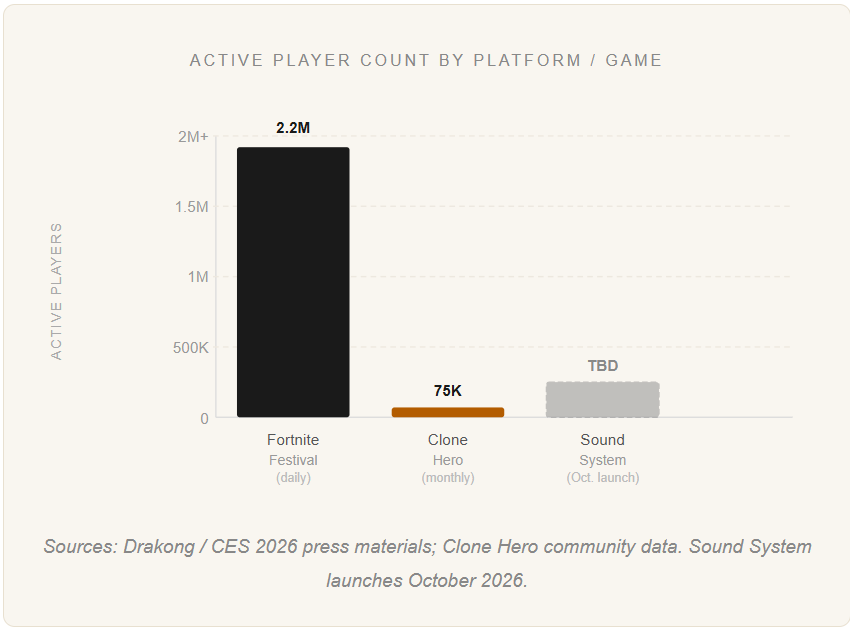
The gap between Fortnite Festival and everything else is enormous. But the real number to watch is Clone Hero’s 75,000 monthly players. That’s a free fan-made game kept alive by a community that never stopped caring. Sound System is what happens when the people who built the genre try to formalize that.
THE INFINAKORE TELECASTER EDITION
The InfinaKore is made by Drakong, a Los Angeles company. They first announced it in June 2025 and brought it to CES this past January for the first public hands-on. The name is a collaboration with Fender, and the Telecaster silhouette isn’t coincidental: 2026 is the Tele’s 75th anniversary.
What makes this controller different from the ones you owned in 2008 is the build philosophy. It’s fully modular. The body, fret buttons, tuner head, whammy bar, and strum bar are all swappable components. Drakong is releasing 3D print files on launch day so players can make their own parts. That’s a real departure from the sealed, break-and-replace peripherals of the Guitar Hero era.
Key Specs
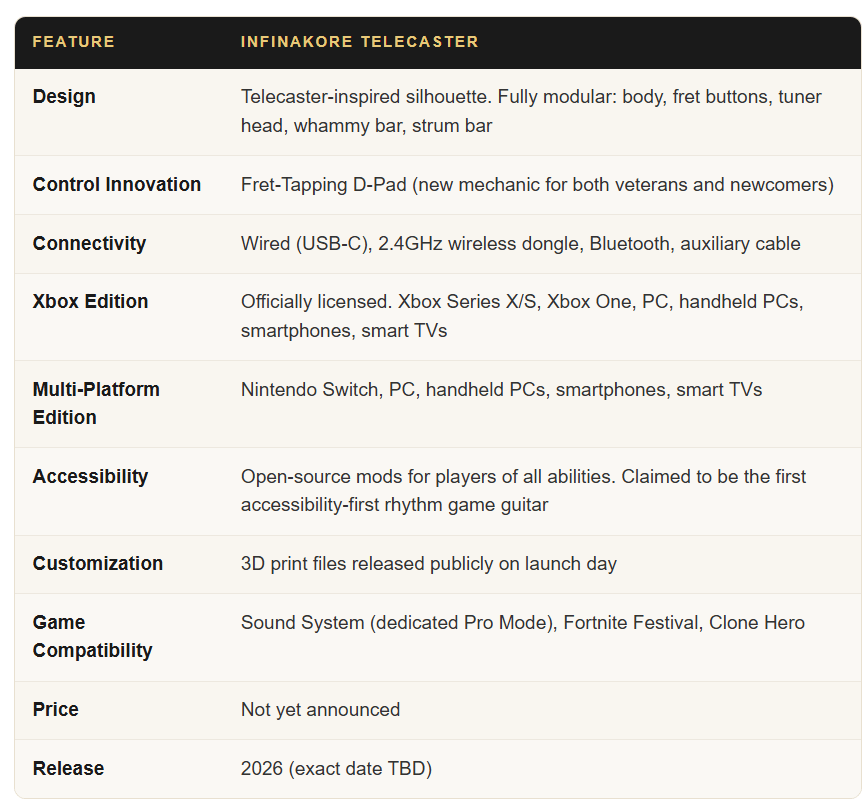
The Fret-Tapping D-Pad is the gameplay angle worth watching. Drakong hasn’t fully detailed how it works yet, but the framing suggests it’s meant to add a technique layer that maps more closely to actual guitar playing, specifically the kind of tapping you see from players like Eddie Van Halen or Steve Vai. Whether that translates to something meaningful in-game or is just a marketing hook is something we won’t know until more hands-on coverage comes out post-launch.
InfinaKore vs. The Controllers You Already Know
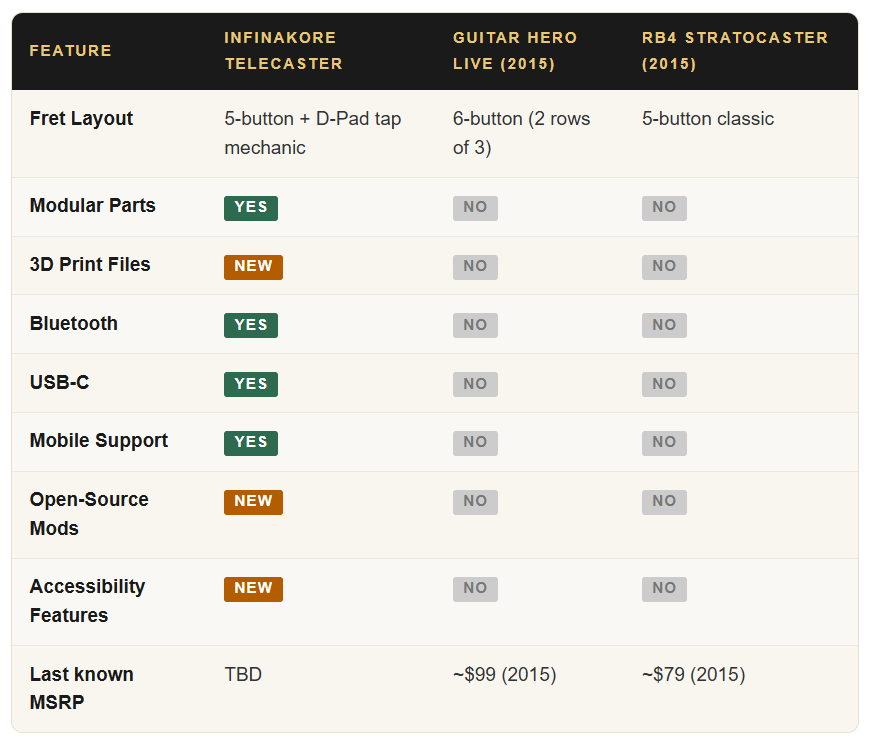
On paper, the InfinaKore is the most forward-looking guitar controller ever announced. The question is whether that modularity holds up in practice and whether the parts actually feel good to play. CES impressions were positive but controlled environments don’t tell you much. We’ll know more once production units hit hands that aren’t at a trade show.
SOUND SYSTEM | THE GAME
The case for Sound System starts with who made it. Marcus Henderson and Lennon Lange founded Echo Foundry Interactive after working on Guitar Hero, DJ Hero, and Band Hero. They know what made that genre work and they know what killed it (largely: too much hardware, too expensive, too fast).
Sound System launches on Steam Early Access on October 16, 2026 for $24.99. Console versions (PS5, Xbox Series, Switch 2) are in development.

The song mix at launch is covers of familiar hits plus original tracks from indie and emerging artists. Core indie tracks are free. Studio-recorded covers run $0.99 each. The pricing model is a direct response to the licensing problem that eventually strangled Guitar Hero and Rock Band: if you build around free and community-made content, the game can’t die because a label pulled a deal.
Feature Breakdown
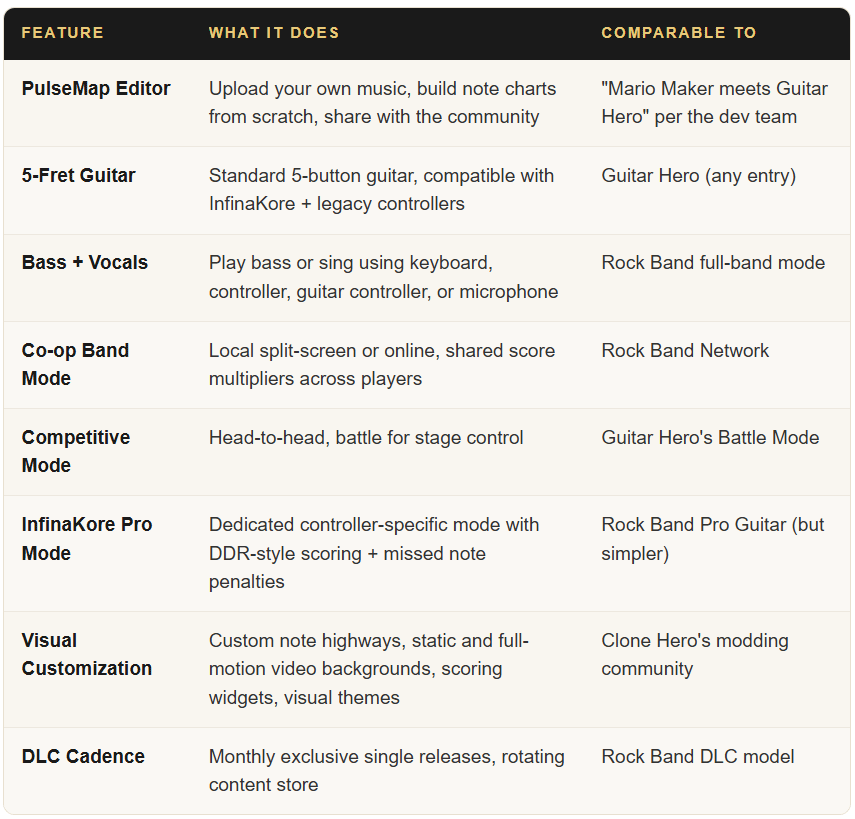
The PulseMap Editor is the part I keep coming back to. Clone Hero’s longevity is almost entirely explained by user-generated charts. Songs go up days after release, fans chart obscure catalog cuts that no licensing deal would ever touch, and the game stays perpetually fresh. Sound System is building that in from day one instead of hoping a community builds it around them later.
WHAT THIS MEANS FOR GUITAR PLAYERS
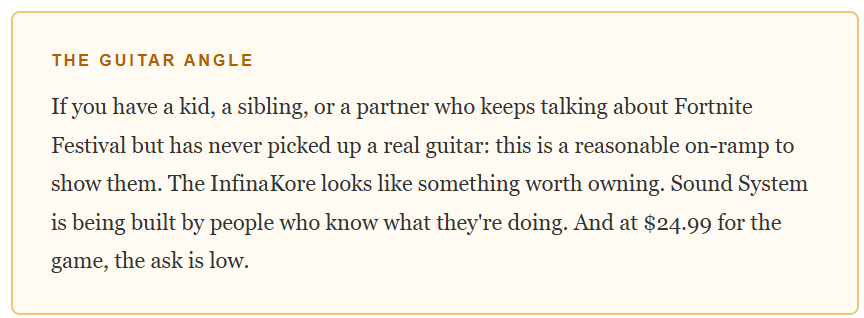
I want to be straight about something: the InfinaKore is a game controller. It is not a guitar. It will not teach you to fret chords or develop your picking hand. The buttons are arranged by color, not by pitch. Playing through a note highway on Expert difficulty will not translate to playing “Little Wing.”
That said, here’s what’s actually happening in this space that matters if you care about guitar culture:
Fortnite Festival has 2.2 million people per day who are actively engaged with music in a way that’s structured around the guitar’s layout. That’s a pool of potential converts. The rhythm game genre has historically created real guitarists. There are working musicians who picked up a real instrument because they got good at the game version first. The pipeline is real, even if it’s not guaranteed.
The Telecaster silhouette on the InfinaKore is not an accident. Drakong is explicitly connecting the controller to the 75th anniversary of one of the most played guitar shapes in history. That framing matters for the guitar-adjacent audience, the person who has always been curious about playing but hasn’t committed to lessons or a real instrument. A controller that looks like a Tele and feels like it has some craft behind it is a different sell than a cheap plastic toy.
And Sound System’s PulseMap Editor means someone can chart a song you love, with the actual guitar part mapped to the note highway, and you can play it. That’s still not playing guitar. But it’s closer to understanding what the song is doing than just listening to it.
THE RHYTHM GAME MARKET | CONTEXT
The rhythm game market is growing again after a decade of dormancy. Numbers vary by source but the direction is consistent:
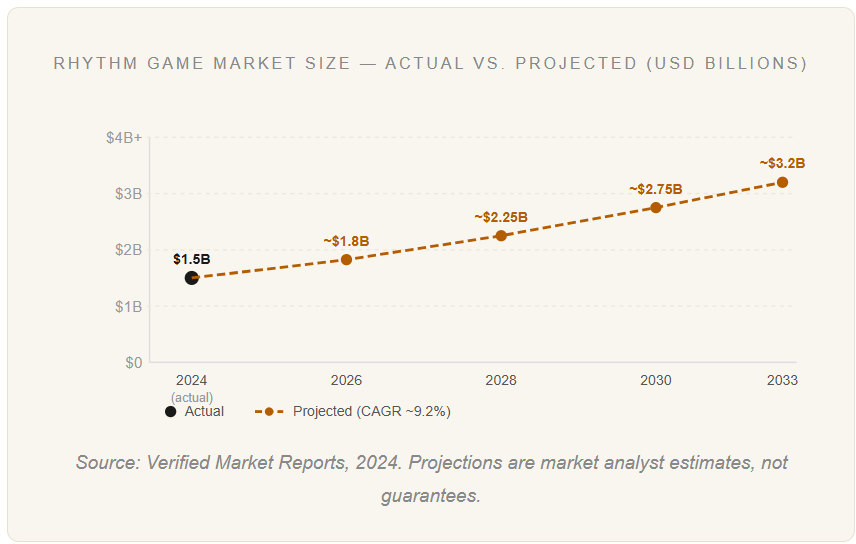
The $1.5 billion figure is from 2024, and it covers rhythm games broadly (mobile included). The 9.2% projected CAGR through 2033 runs parallel to the period when Sound System, the InfinaKore, and whatever comes after them will be building their player bases. Whether those projections hold depends on whether new titles can actually retain players, not just attract them at launch.
BOTTOM LINE
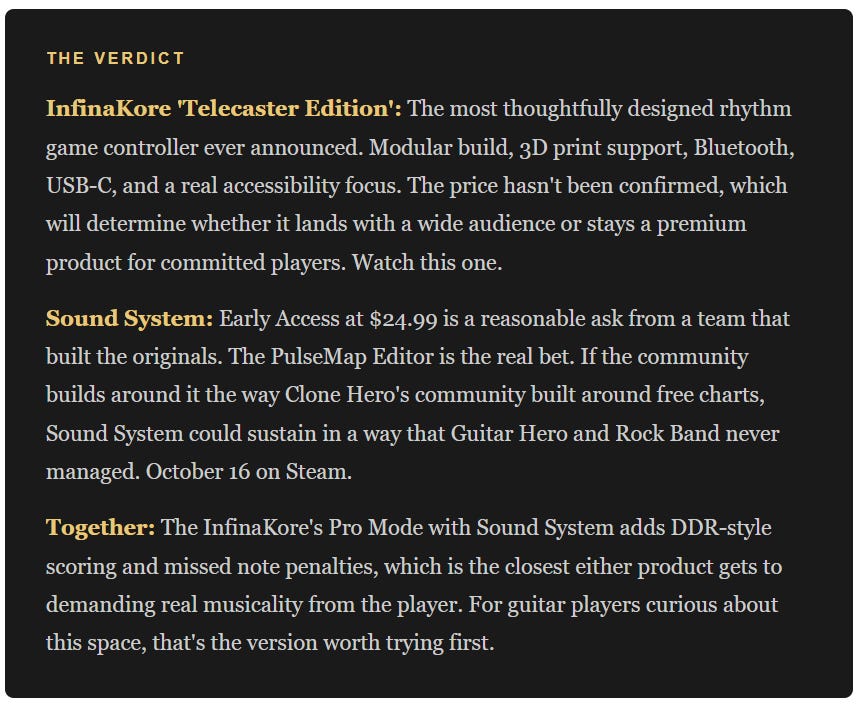
Both products are still pre-launch at the time of this piece. Hands-on reviews post-ship will tell us whether the InfinaKore’s modularity is actually durable and whether Sound System’s community editor gets real traction. The foundation is there. Whether the execution matches is a question we’ll have a better answer to by the end of the year.
More information: drakong.com | playsoundsystem.com