Lighter Strings, Easier Bends
One gauge change fixes more stuck bends and dead vibrato than a year of practice. Here’s the physics behind it, what it costs, and how to switch without wrecking your tone.

TECHNIQUE DEEP DIVE
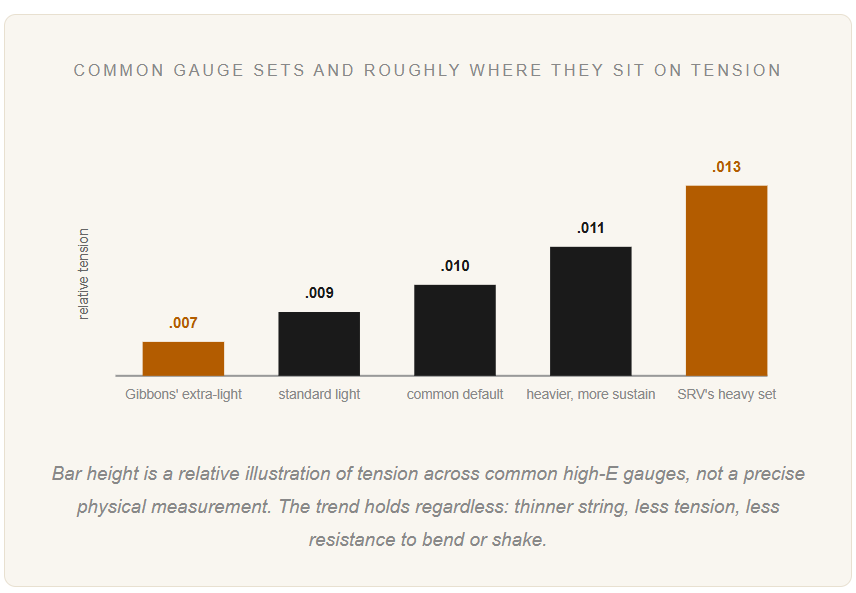
B.B. King once watched a young Billy Gibbons fighting his way through a bend on a set of heavy strings and asked him a simple question: why are you working so hard? Gibbons took the advice seriously. He dropped down to a .007 high E, a gauge most players have never even held, and built an entire career on bends and vibrato that sound like they cost him nothing, because for him, they basically don’t.
Stevie Ray Vaughan went the opposite direction. He played a .013 high E, sometimes heavier, and bent it like it was nothing. It also wore holes in his fingertips and is part of why he eventually had to drop to an .011.
Same instrument, same techniques, two completely different physical experiences. The difference is string gauge, and it’s one of the cheapest, fastest changes you can make to how bending and vibrato actually feel under your fingers.
What Gauge Actually Controls
String gauge is just the diameter of the string, measured in thousandths of an inch. A “light” set might run .009 to .042 across six strings. A “heavy” set might run .011 or .012 up to .052 or higher.
Thicker strings need more tension to reach standard pitch than thinner ones do. More tension means more resistance every time you push a string across the fret to bend it, or rock it back and forth for vibrato. That resistance is the whole story. It’s why a beginner can wrestle with a heavy-gauge guitar for months and still can’t get a clean whole-step bend, then borrow a friend’s light-strung guitar and bend it on the first try.