
Reactive Living Is Slowly Robbing You Blind
Unplanned weeks don’t explode your life overnight, they quietly erode your momentum, your confidence, and your future leverage.
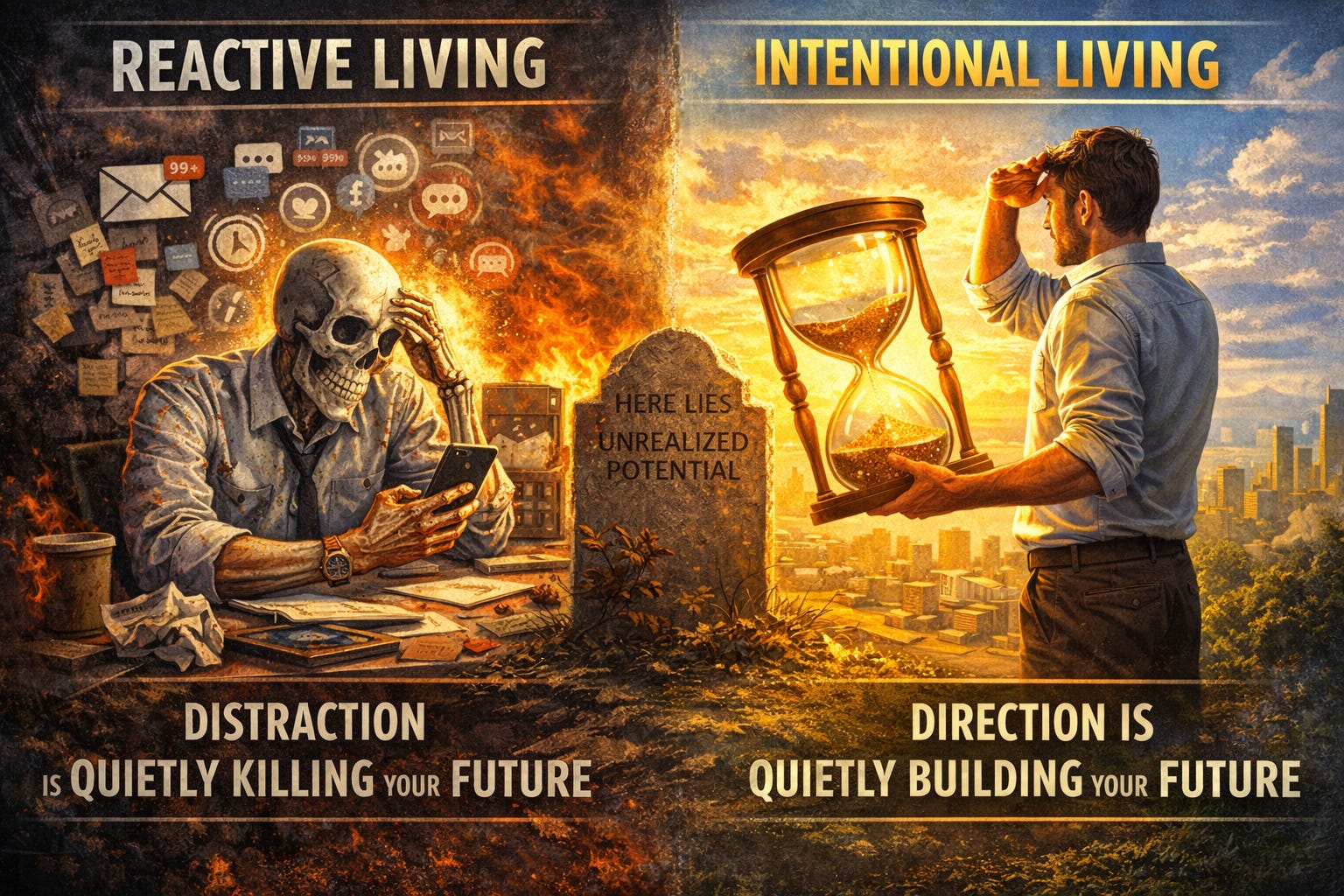
Most people believe their biggest risk is failure.
It isn’t.
It’s drift.
Drift disguised as busyness.
Drift disguised as responsibility.
Drift disguised as productivity.
Reactive living doesn’t announce itself as a problem. It doesn’t look like collapse. It doesn’t look like disaster. It looks like answering emails quickly. It looks like showing up to meetings. It looks like handling what’s in front of you. It looks like being available.
It looks normal.
And that’s exactly why it’s dangerous.
Because over time, unplanned weeks don’t just waste hours, they compound in reverse.
The Subtle Architecture of a Reactive Week
A reactive week usually begins with good intentions.
You open your laptop on Monday morning with a vague idea of what you “should” work on. Before you define the week, you check your inbox. You check Slack. You scroll briefly “just to see what’s happening.” A few messages need attention. A few small fires need to be handled. A request feels urgent.
You respond.
By the time you look up, the morning is gone.
You still worked. You were busy. You solved problems.
But you didn’t move your most important priority forward.
And so the pattern repeats.
Tuesday becomes adjustment day. Wednesday becomes catch-up. Thursday becomes fatigue management. Friday becomes damage control.
Nothing catastrophic happened.
But nothing compounded either.
The Metrics of Drift
Let’s look at this objectively.
Research shows knowledge workers check communication tools every 6–12 minutes. After each interruption, it can take over 20 minutes to regain full focus. Even if those numbers fluctuate, the pattern is clear: constant context switching destroys depth.
If you lose just 60–90 minutes per day to fragmented attention, that adds up to:
5–7.5 hours per week
20–30 hours per month
240–360 hours per year
That’s the equivalent of six to nine full workweeks of deep, uninterrupted effort.
Imagine what six uninterrupted weeks could build.
A certification.
A portfolio.
A revenue stream.
A body of creative work.
A meaningful skill upgrade.
Most people don’t lack ambition. They lack protected hours.
Reactive living steals those hours invisibly.
Why Reactive Living Feels Responsible
There’s a reason we fall into it.
Reacting feels virtuous.
You’re responsive. You’re dependable. You’re handling what’s in front of you. You’re clearing tasks. You’re checking boxes. You’re available.
It feels mature.
Planning, on the other hand, requires discomfort.
Planning forces you to decide what matters most. It forces you to disappoint lesser priorities. It forces you to ignore some requests. It forces you to confront trade-offs.
That feels risky.
So instead, we stay available.
And availability slowly replaces intentionality.
The Identity Shift You Don’t Notice
The greatest cost of reactive living isn’t time.
It’s identity.
Over months and years, you begin to see yourself not as a builder, but as a responder.
You stop thinking, “What am I creating?”
You start thinking, “What needs my attention?”
Your role subtly shifts from architect to operator.
And once that shift happens, your confidence erodes quietly.
Because reactive progress feels accidental. And accidental progress doesn’t build belief.
Intentional progress does.
Momentum: Built or Borrowed?
Momentum is not an emotional state.
It’s a structural outcome.
It emerges when clarity meets repetition.
When you define a direction and return to it consistently, progress compounds. But when direction changes daily based on urgency, repetition disappears. And without repetition, there is no compounding.
Reactive living creates a constant state of borrowed momentum.
You feel movement because you’re busy.
But busyness is not direction.
It’s motion without accumulation.
And motion without accumulation is exhausting.
The Compound Cost Over Years
Let’s zoom out.
Imagine two professionals over a five-year span.
The first lives reactively. They work hard. They respond quickly. They are always “on.” They rarely define long-term priorities in advance. Their weeks are dictated by incoming demands.
The second person works just as hard, but designs their week before it begins. They define one compounding priority. They protect two focused work blocks. They evaluate progress weekly.
The difference isn’t daily intensity.
It’s accumulated direction.
If the structured person invests just five focused hours per week into skill development or asset building, that’s 260 hours per year. Over five years, that’s 1,300 hours of deliberate improvement.
That is not a marginal difference.
That is a transformation.
The reactive person didn’t waste time. They simply never concentrated it.
And concentrated effort is what changes trajectories.
The Emotional Toll of Unplanned Living
There’s another cost few people talk about.
Reactive weeks generate a subtle narrative:
“I’m always catching up.”
That narrative becomes identity.
You feel slightly behind even when you’re performing well. You feel like there’s always something unresolved. You struggle to experience completion because the week was never designed around a clear finish line.
Chronic reaction leads to chronic tension.
And tension without direction becomes burnout.
The Financial Implications
Reactive living also delays financial leverage.
When you don’t carve out intentional time for skill development, strategy, or asset building, you remain dependent on linear income. You trade hours for results, over and over.
Even a modest 10–15% skill improvement can significantly alter earning potential over time. But that requires sustained focus.
Focus requires structure.
Structure requires intention.
And intention requires planning.
Why It Doesn’t Feel Urgent
The most dangerous part?
There is no immediate penalty.
No alarm goes off when you fail to plan Sunday evening. No one fires you for responding too quickly. No immediate crisis emerges.
The penalty accumulates silently.
Stagnation is rarely explosive.
It’s incremental.
And incremental drift is easy to rationalize.
Reclaiming Direction Without Rigidity
You don’t need a hyper-optimized productivity system.
You need a designed week.
Start with three commitments:
Define one core priority before the week begins.
Protect two uninterrupted deep work sessions.
Review progress every Sunday.
That’s it.
You don’t eliminate responsiveness…you contain it. You don’t reject responsibility, you sequence it.
You respond after you initiate.
That small shift changes everything.
What Changes When You Stop Living Reactively
When your week has structure:
Stress decreases because decisions are pre-made.
Confidence increases because progress is visible.
Output improves because focus compounds.
Creativity resurfaces because space exists.
Financial clarity improves because you think beyond urgency.
You begin to feel ahead instead of behind.
Not because life got easier.
But because direction replaced drift.
The Five-Year Question
Project yourself five years forward.
If nothing meaningfully changes, what will the reason be?
Lack of intelligence?
Lack of work ethic?
Or lack of structured direction week after week?
Most people overestimate what they can accomplish in a month and underestimate what they can build in five years of consistent, intentional focus.
The difference between stagnation and transformation is rarely talent.
It’s design.
This is not about overhauling your life.
It’s about redesigning your next seven days.
Before this week begins:
Choose one priority that compounds.
Block two 90-minute deep work sessions.
Decide what can wait.
Write your weekly focus somewhere visible.
Review it each morning before opening email or Slack.
Protect just three to five hours of intentional momentum this week.
If you do that consistently, you generate over 200 hours of directed growth per year.
That is how identities change.
That is how careers shift.
That is how creative lives revive.
Reactive living is expensive, but the invoice arrives slowly.
Stop financing drift.
Start compounding direction.
This week.


