

Stop Racing a Clock That Isn’t Yours
Music doesn’t reward speed, it rewards depth, honesty, and staying in the game.
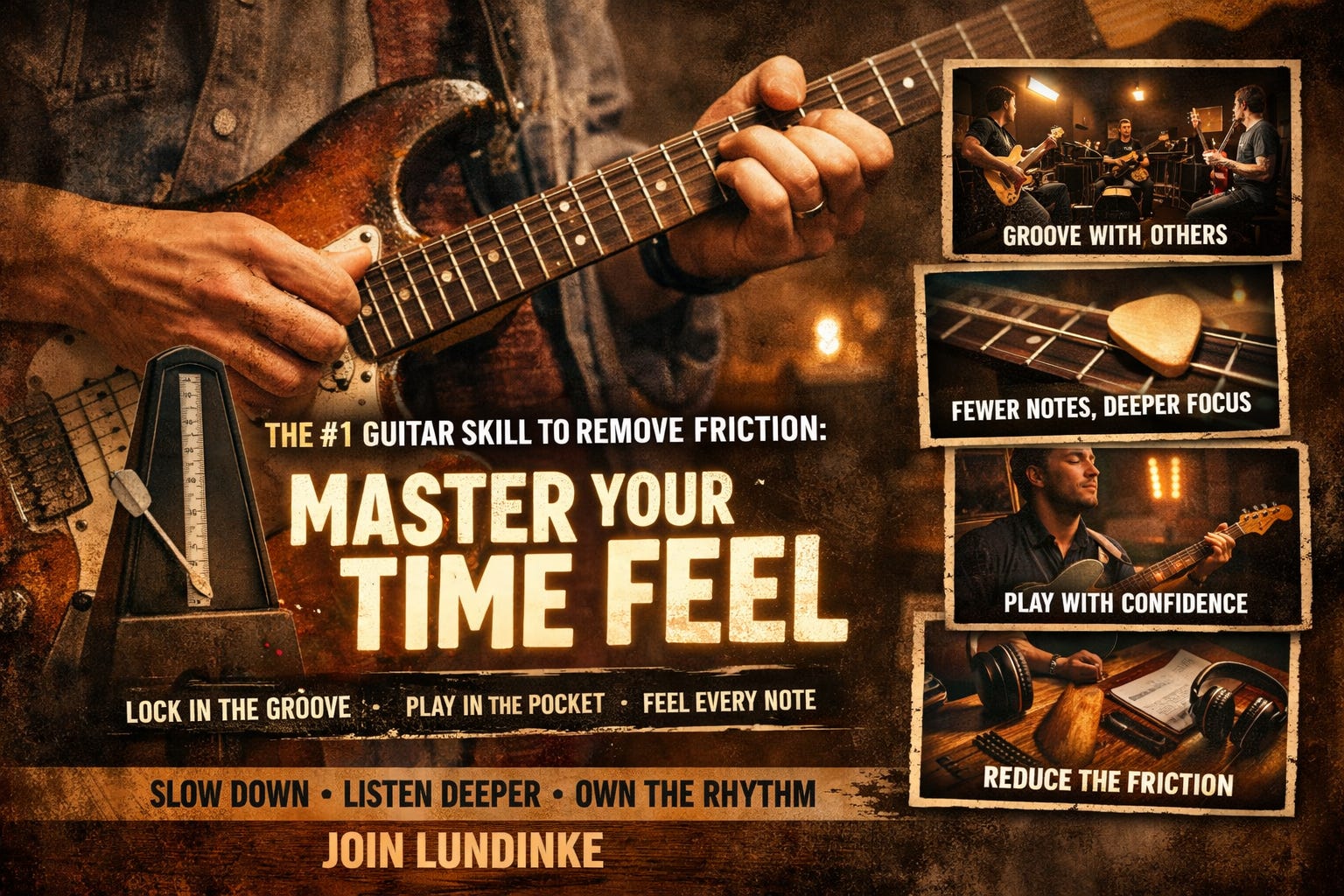
Here’s the uncomfortable truth I wish someone had told me earlier:
The guitar skill that removes the most friction isn’t speed.
It isn’t theory.
It isn’t tone, gear, modes, or exotic scales.
It’s time.
More specifically: time feel and rhythmic control.
I know—anticlimactic. Not sexy. No Instagram fireworks.
But stay with me, because this is one of those rare skills that quietly fixes everything else.
Why guitar feels hard even when you “know enough”
Most guitar frustration doesn’t come from lack of knowledge.
It comes from friction.
That feeling when:
You know what to play, but it doesn’t land
Your hands are fine alone, but fall apart with others
You practice a lick for weeks and it still sounds stiff
You avoid jamming because you don’t “lock in”
You feel rushed… or late… or invisible in the mix
That friction drains confidence faster than missed notes ever could.
And here’s the kicker:
Almost all of it traces back to rhythm.
The hidden tax of weak time feel
When your time isn’t solid, everything costs more:
Simple parts require excessive focus
Fast passages feel impossible
Groove-dependent styles feel “off limits”
Playing with others feels risky
Practice sessions feel exhausting instead of energizing
You end up compensating:
Overplaying to feel relevant
Speeding up to mask insecurity
Avoiding space because silence exposes timing
Memorizing shapes instead of feeling phrases
That’s not a talent issue.
That’s a timing issue.
The “aha moment” most guitarists never have
Here’s the shift that changes everything:
Good time makes simple playing sound impressive.
Bad time makes impressive playing sound amateur.
Read that again.
A single note, placed perfectly, will outperform a flurry of notes placed poorly….. every time.
This is why:
Funk guitarists sound deadly with two notes
Jazz comping feels expensive even when sparse
Great rhythm players get called back
Session players work forever
They remove friction for everyone else.
Why time feel is leverage, not limitation
Most players think rhythm work “slows you down.”
In reality, it unlocks speed, freedom, and confidence.
When your internal clock is strong:
Fast passages relax
Syncopation feels playful, not stressful
Space feels intentional
Mistakes recover smoothly
Other musicians trust you instantly
Time feel is musical credibility.
You don’t have to announce it.
People feel it.
The difference between counting and owning time
Let’s clarify something important.
Time feel is not:
Counting mechanically
Staring at a metronome
Practicing like a robot
Becoming stiff or rigid
Great time feel is elastic. Human. Alive.
It’s the ability to:
Sit slightly behind the beat on purpose
Push energy forward without rushing
Lay back without dragging
Place notes with confidence
Maintain pulse even when everything drops out
That’s not math.
That’s ownership.

The single habit that builds time feel faster than anything else
If I had to reduce this to one practice behavior, it would be this:
Practice fewer notes, deeper in time.
Not more notes.
Not harder notes.
Not faster notes.
Fewer notes. Better placement.
That alone removes massive friction.
A practical reset you can use today
Here’s a dead-simple starting point that works at any level.
Exercise 1: The one-note truth test
Set a metronome to a slow tempo (60–70 BPM)
Play one note
Place it exactly on the click
Let it ring
Don’t fill space
Listen deeply
Then:
Try placing the note slightly behind the click
Try slightly ahead
Return to dead center
You’re training control, not speed.
Most players rush past this because it feels “too basic.”
That’s the friction talking.
