

Sustainable Shredding
Are FSC-Certified Tonewoods Actually Changing Your Tone?

Gear & Sustainability
Walk into any guitar shop today and you will hear the word “sustainable” on a hang tag within about 30 seconds. Taylor’s got an ebony mill in Cameroon. Martin’s been printing FSC logos since before most players knew what FSC stood for. Gibson spent years fighting the government over its wood sourcing before pivoting to certified alternatives. The story is everywhere now.
But here is the question most of those hang tags don’t answer: if your guitar is made from FSC-certified wood instead of whatever they were using before, does it sound different?
Short answer: the certification itself doesn’t change a thing. What does matter, and what most players are actually asking about without knowing it, is species substitution. Because when the regulations started closing in, guitar companies didn’t just get paperwork on the same wood. They switched to different trees entirely. And that is where the tonal question gets real.
WHAT FSC ACTUALLY CERTIFIES
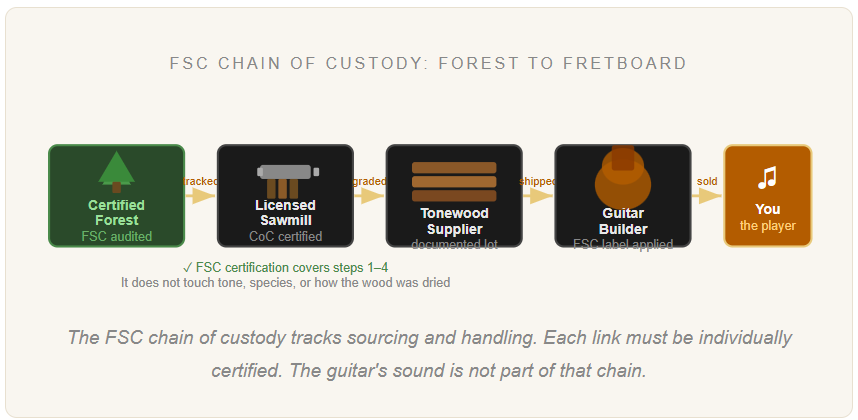
The Forest Stewardship Council is a non-profit that sets standards for forest management: labor practices, ecological impact, replanting, chain of custody. If a guitar company buys FSC-certified mahogany, it means the wood was harvested from a forest operating under those standards. That is it.
FSC certification doesn’t change the species. It doesn’t change how the wood was dried, cut, or graded. It doesn’t change the grain pattern or the density or the stiffness. A certified Honduran mahogany neck and a non-certified Honduran mahogany neck, from the same region, same growth rate, same cut, will sound the same.
The Actual Question
The tonal debate isn’t about certification. It’s about what happened when companies had to stop using the wood they’d always used and replace it with something else. Two back-to-back regulations made that substitution unavoidable for most major builders.
First, the Lacey Act. Amended in 2008 to cover plants and plant products, it made it illegal to import or sell wood harvested in violation of foreign laws. The US Fish and Wildlife Service raided Gibson’s Nashville factory in 2009, and again in 2012, over rosewood and ebony imports from Madagascar and India. Gibson settled in 2012 for $300,000. The message was clear: provenance mattered now.
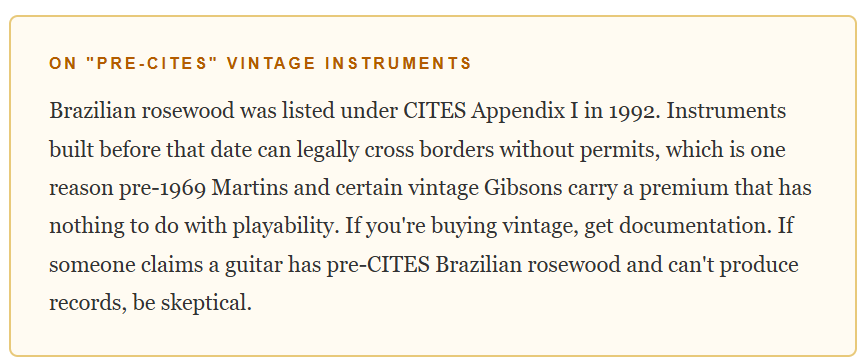
Second, the 2017 CITES Appendix II listing of all Dalbergia species. Dalbergia is the genus that covers most rosewoods: Brazilian rosewood, Indian rosewood, Madagascar rosewood, cocobolo, kingwood. Under CITES Appendix II, any international trade in Dalbergia requires permits and documentation. That turned rosewood fretboards into a supply chain headache overnight. Companies building 50,000 to 500,000 guitars a year could not sustain the paperwork burden. Most of them moved to something else.
WHAT THEY SWITCHED TO
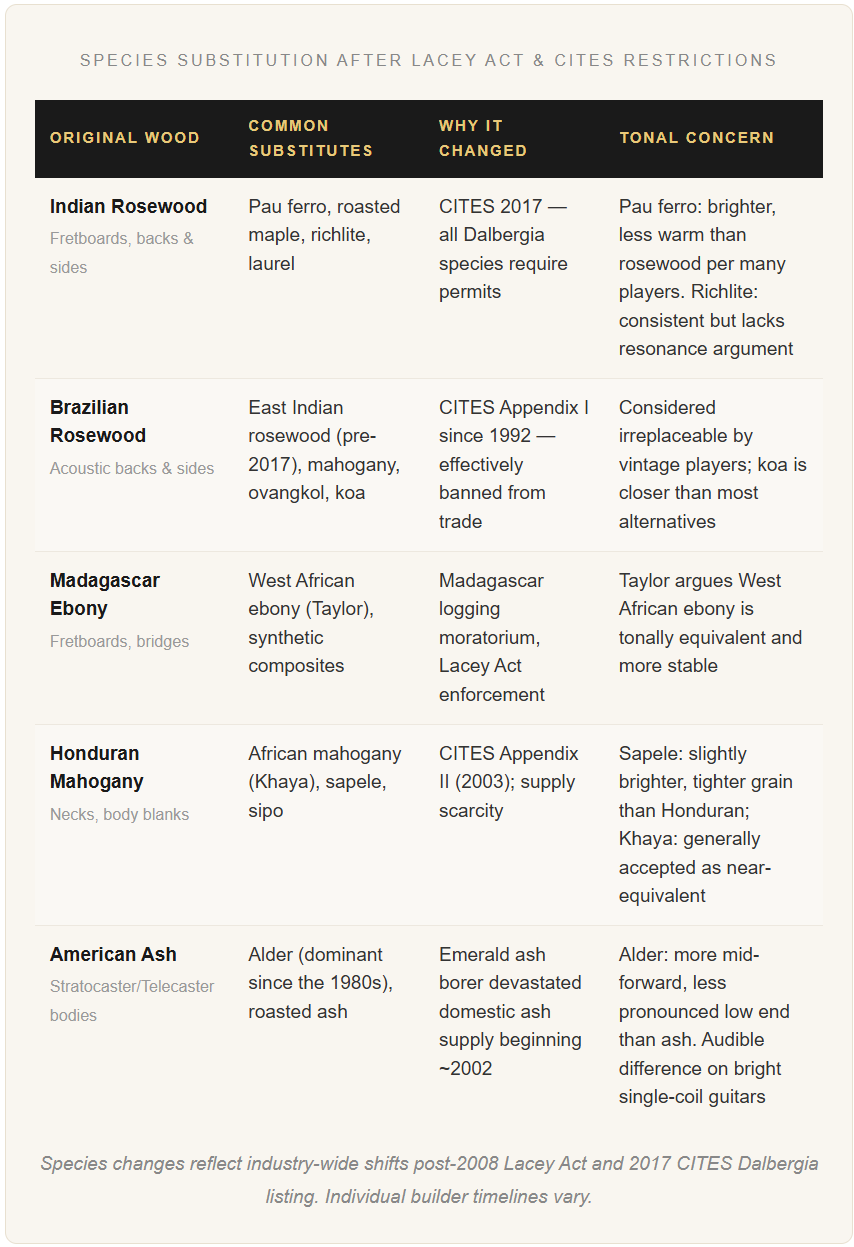
This is where tone enters the picture. The table below shows the common substitutions that happened across the industry after 2017. These are real species changes, not just sourcing changes. Each one has different physical properties, which means each one potentially has different acoustic properties.
THE NUMBERS BEHIND THE WOOD
Wood tone is physics. Density, stiffness, and internal damping are the three variables that acousticians actually measure. Density affects how much mass the vibrating string has to drive. Stiffness affects how efficiently the wood converts string energy into sound. Internal damping affects how quickly that energy dies out.
The chart below shows density figures for the tonewoods that matter most to this conversation. Higher density generally means more sustain and a tighter, brighter response. Lower density generally means easier to vibrate, which can translate to more warmth and faster attack decay.
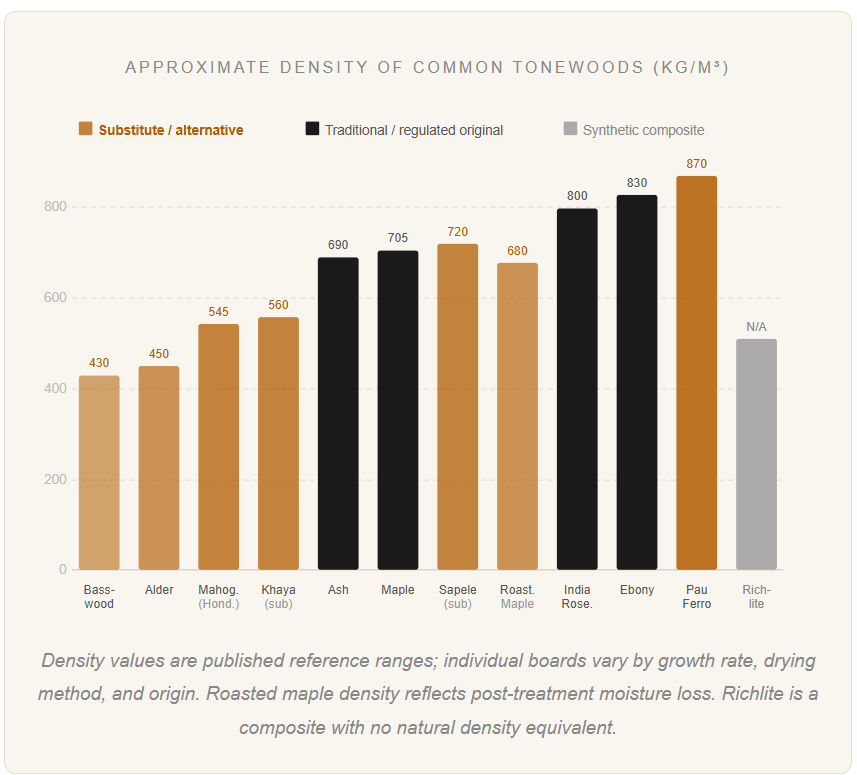
The density gap between Indian rosewood (800 kg/m³) and pau ferro (870 kg/m³) is real but small. The gap between Indian rosewood and roasted maple (680 kg/m³) is much larger, and roasted maple is now one of the most common fretboard substitutes on production instruments. Whether your ear catches that is a different question.
DOES ANY OF THIS ACTUALLY CHANGE WHAT YOU HEAR?
This is where the conversation usually turns into a religion war. So let’s separate what is known from what is debated.
What is physically true: different wood species have different density, stiffness, and damping properties. These properties affect how vibrations travel through the instrument. Acoustic physics says this should produce measurable differences in the frequency response of the guitar body and neck.
What blind testing tends to show: players are significantly worse at identifying these differences than they think they are. Multiple informal tests and at least one published study (Hahn & McIntyre, 2014, on acoustic guitar backs and sides) found that listeners could not reliably distinguish between tonewood species when the guitar was played behind a screen or when they couldn’t see what wood was in the instrument. The “rosewood sounds warmer than maple” claim has very weak blind-test support.
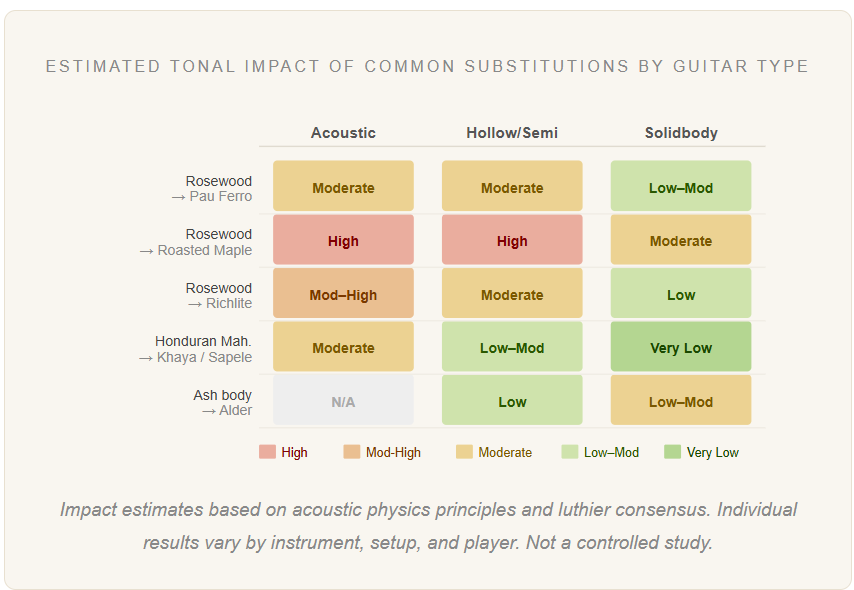
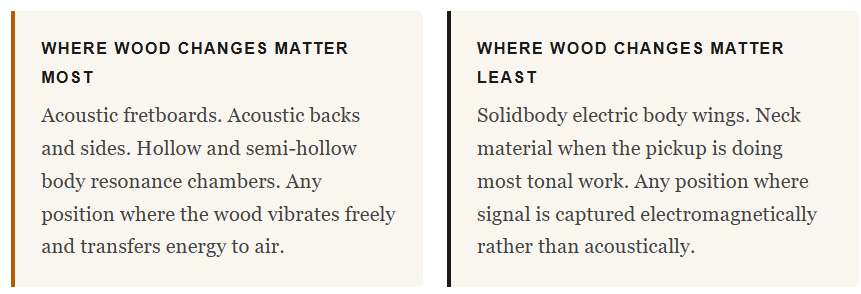
Where the substitution probably does matter: fretboards. This is the one place where your fretting hand is in direct contact with the wood, and the open-string resonance of the fretboard material contributes more directly to the tone you hear than a back or side panel that’s further from the strings. The jump from Indian rosewood to roasted maple is the most significant substitution in common use right now, and a real density difference of 100+ kg/m³ is more likely to be audible than a swapped back panel.
Where it almost certainly doesn’t: body wings on solid body electrics. The physics of how a solid body electric converts string vibration to electrical signal via a pickup means the wood body contributes far less to the raw output than on an acoustic. The pickup hears the string. Not the body. Ash vs. alder debates on a Stratocaster body are real enough that they affect resonance and feel, but the recorded output difference through an amp is far more subtle than most players claim.
THE PRACTICAL VERDIT
Here is what this actually means for you as a player shopping for a guitar right now.
If you’re buying an acoustic, the fretboard material matters more than the back and sides. A rosewood-to-pau-ferro swap on an acoustic dreadnought is audible under the right conditions and worth comparing in person. A rosewood-to-Richlite swap may be harder to hear but will likely feel different under your fingers. If you’re sensitive to texture and warmth, play both before committing.
If you’re buying a solid body electric, the fretboard swap matters less, and the body wood swap matters very little. A Stratocaster with a pau ferro fretboard will sound like a Stratocaster. The pickup, the amp, and your hands are doing 90% of the work. Don’t let a tonal debate about fretboard wood distract you from the setup, the fret work, and how the neck feels in your hand.
If you’re buying a semi-hollow or archtop, you are in the middle ground. Body resonance is genuinely part of the tone in a way it isn’t on a solid-body. The wood matters more than it does on a Les Paul, less than it does on a Martin dreadnought.
THE PART NOBODY IN THE INDUSTRY WANTS TO SAY
FSC certification is genuinely good. The forests it protects are real. The certification process has real standards. Supporting it by buying from manufacturers who use it is a real choice with real consequences for logging practices in places where oversight is otherwise minimal.
But the way it gets marketed to guitar buyers is mostly about feel-good branding, not tone. “Sustainable tonewoods” printed on a hang tag tells you almost nothing about how the instrument sounds. It tells you something about where the wood came from.
The actual tonal question, which is more honest, is: does the species substitution your guitar underwent sound different from what it replaced? And the answer to that is: sometimes, a little, in specific positions (fretboard more than body), on specific guitar types (acoustic more than solid body), and mostly less than you’d expect from reading the forums about it.
Play the guitar. Judge the sound. The certification is for the forest, not for your ears.
Send this to someone about to buy a "sustainable" guitar.