

The $500 Guitar Problem
Why Squier in 2026 is exposing uncomfortable truths about price, prestige, and what actually matters in tone

For decades, guitar culture operated on a simple assumption. Expensive instruments were better. Not slightly better. Significantly better. A clear hierarchy existed. Entry-level guitars were stepping stones. Mid-tier guitars were compromises. High-end instruments were the destination. The Fender Custom Shop sat at the top as the gold standard, while Squier lived at the bottom as the beginner’s starting point.
That hierarchy is breaking down in 2026.
Not slowly. Not subtly.
Decisively.
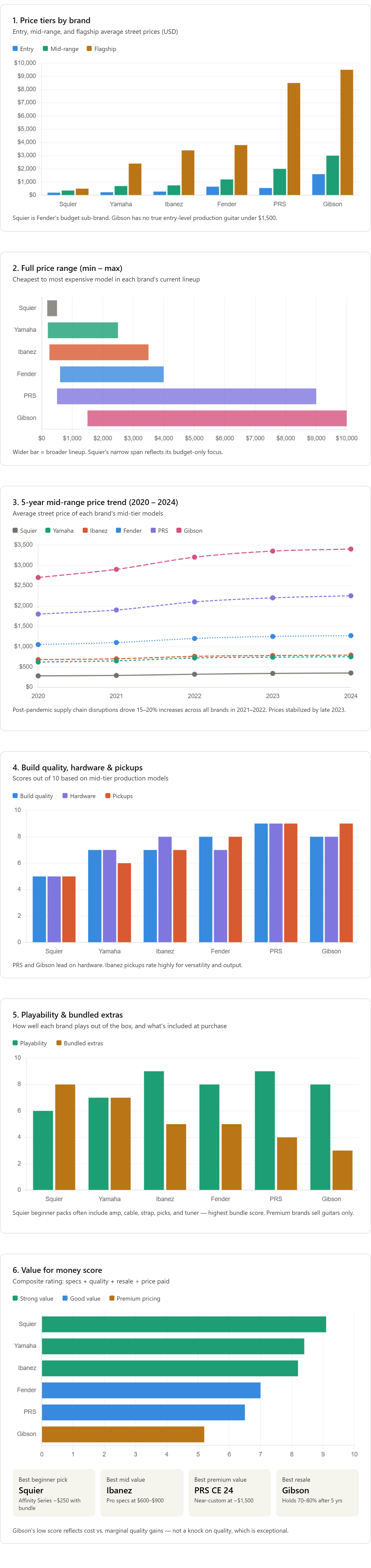
The uncomfortable reality is that a well-selected $500 guitar today can perform, record, and hold tuning stability in ways that make many premium instruments feel like diminishing returns. This is not a claim driven by hype. It is a reflection of manufacturing evolution, supply chain standardization, digital measurement, and a shift in how musicians actually use their instruments.
The debate is no longer emotional. It is structural.
And it forces a deeper question. What are you really paying for when you buy a high-end guitar?
The Manufacturing Gap Has Collapsed
The biggest shift is not visible from the outside. It is inside the production process.
Twenty years ago, budget guitars suffered from inconsistent fretwork, poor neck stability, weak electronics, and unreliable hardware. These were not minor flaws. They affected playability and tone in obvious ways. Higher-end guitars justified their cost because they solved those problems.
That gap has narrowed dramatically.
Modern CNC machining has standardized neck shaping to tolerances that were once only achievable through experienced luthiers. Factories that produce instruments for multiple brands now operate under shared quality benchmarks. Quality control has improved because defects are easier to detect and correct early in the process.
A $500 guitar in 2026 benefits from:
Precision fret placement with minimal variance
Stable neck construction with improved truss rod systems
Better nut materials and cutting consistency
Hardware that holds tuning under real-world use
These are not luxury features anymore. They are baseline expectations.
The result is simple. Playability is no longer exclusive to high price points.
Electronics Are No Longer the Weak Link
Pickups used to be the easiest way to identify a budget guitar. They lacked clarity, output balance, and dynamic response. Today, that difference has compressed.
Manufacturers have access to better magnet materials, more consistent winding techniques, and improved quality control. Even stock pickups in mid-range instruments now deliver usable tones across clean and driven contexts.
More importantly, players have changed their behavior.
Pedals, amp modeling, and digital processing have shifted the tone equation. The raw signal of the guitar is still important, but it is now part of a larger system. A well-set-up $500 guitar running through a modern signal chain can produce tones that would have been considered studio-ready a decade ago.
The question is no longer whether the guitar is “good enough.” It is whether the player understands how to shape the signal.
Consistency Beats Exception
High-end guitars still offer something real. The best Custom Shop instruments are exceptional. The issue is not quality. The issue is consistency relative to price.
A $4,000 instrument is expected to be perfect. A $500 instrument is expected to be functional. When a $500 guitar arrives with strong fretwork, stable tuning, and balanced pickups, it exceeds expectations. When a $4,000 guitar arrives with minor imperfections, it fails expectations.
Expectation gap drives perception.
Modern mid-tier guitars benefit from consistent manufacturing. You are less likely to encounter extreme variance. With high-end instruments, you are often paying for the possibility of greatness rather than the guarantee of it.
That distinction matters in real use.
The Player Has More Leverage Than Ever
In 2026, the guitarist is not limited by access to information or tools.
Setup knowledge is widely available. Players understand how to adjust action, intonation, and pickup height. Replacement parts are affordable and accessible. A $500 guitar can be upgraded incrementally rather than replaced entirely.
This creates leverage.
Instead of spending $4,000 upfront, a player can:
Buy a $500 instrument with strong fundamentals
Invest $150 to $300 in pickups if needed
Perform or pay for a professional setup
Replace small components over time
The total investment remains significantly lower, while performance approaches or matches higher-end instruments in practical scenarios.
This is not theory. It is happening across bedrooms, studios, and stages.
Elevate Your Play
The most important shift is psychological.
When you remove the belief that better gear equals better results, you are forced to confront your actual skill level. A well-built $500 guitar reveals your timing, your touch, your phrasing, and your control. It does not hide behind prestige.
Players who grow in this environment develop stronger fundamentals.
They focus on:
Clean execution
Consistent dynamics
Intentional tone shaping
Efficient practice habits
The instrument becomes a tool rather than an identity marker.
That is where real progress happens.
The Prestige Premium
High-end guitars still carry value. Craftsmanship, aesthetics, brand history, and emotional connection matter. The problem is not that premium instruments exist. The problem is the assumption that they are necessary for performance.
There is a difference between value and justification.
A Custom Shop guitar may offer:
Hand-selected wood
Unique finishes and relic work
Detailed attention to aesthetic elements
Brand heritage and collectibility
These are real attributes. They are also difficult to quantify in terms of measurable performance.
You are not just buying a tool. You are buying a story.
There is nothing wrong with that. But it should be understood clearly.
The Studio Reality
Recording environments expose truth quickly.
Engineers care about:
Tuning stability
Noise levels
Intonation
Consistency across takes
A properly set up mid-tier guitar can meet all of these requirements.
In blind listening tests, differences between guitars often become less obvious once tracks are processed, layered, and mixed. Tone is shaped by context. The mix matters more than the individual signal in isolation.
This does not mean all guitars sound the same. It means the gap between “usable” and “exceptional” is smaller than many assume.
And in most recordings, “usable” is enough.
Do This
If you want to test this shift in a practical way, remove assumptions and create a controlled comparison.
Play a $500 guitar and a high-end instrument through the same amp or modeler. Record identical parts. Listen back without knowing which is which. Evaluate:
Clarity
Dynamics
Tuning stability
Feel in the mix
Then assess your playing.
Where are inconsistencies coming from?
Are they tied to the instrument or your execution?
This process removes bias and forces objective evaluation.
The Economic Shift
The broader market reflects this change.
Demand for mid-tier instruments has increased because players recognize the value. Manufacturers respond by improving quality at those price points. Increased competition pushes innovation downward rather than upward.
This creates a feedback loop.
Better mid-tier guitars increase expectations.
Higher expectations force brands to improve.
Improved quality reduces the need for premium upgrades.
The result is a more efficient market.
Your Move
You do not need to abandon high-end guitars. You need to understand them.
If you want craftsmanship, history, and emotional connection, premium instruments deliver. If you want performance, reliability, and value, modern mid-tier guitars can meet your needs.
The decision should be intentional.
Buy based on how you play, not how you think you are supposed to play.
Test instruments without looking at the headstock.
Invest in setup before upgrades.
Focus on consistency before tone chasing.
The hierarchy is no longer fixed.
A $500 guitar in 2026 is not a compromise. It is a legitimate platform.
And that changes everything.
Because once the tool is no longer the limitation, the responsibility shifts back to the player.
That is where the real debate begins.


Ron Watson documents the intersection of guitar, mindset, and modern creative work at Lundinke. A lifelong guitarist, he began learning classical scales at age ten before building a career in finance, technology, and corporate leadership. Years later, the rhythmic pulse of samba rekindled his passion for both acoustic and electric guitar, sparking a creative reset that reshaped how he approaches growth, discipline, and purpose. Through Lundinke, Ron helps guitarists and professionals build clarity, consistency, and confidence on and off the fretboard. He explores how musical skillsets translate into sustainable careers and personal transformation. He still cringes at his early content and proudly publishes daily to serve a global community of players in motion.