The Architect of Inevitability
How John Mayer Convinced Every Generation That He Is the Only Thing That Matters
GUITAR & CULTURE MAY 2026
He has done it twice, to two completely separate cohorts of guitarists, and he may be about to do it again. The machinery behind John Mayer’s brand is more sophisticated than any other musician alive, and the line between genuine artistry and masterclass-level self-promotion has never been blurrier.
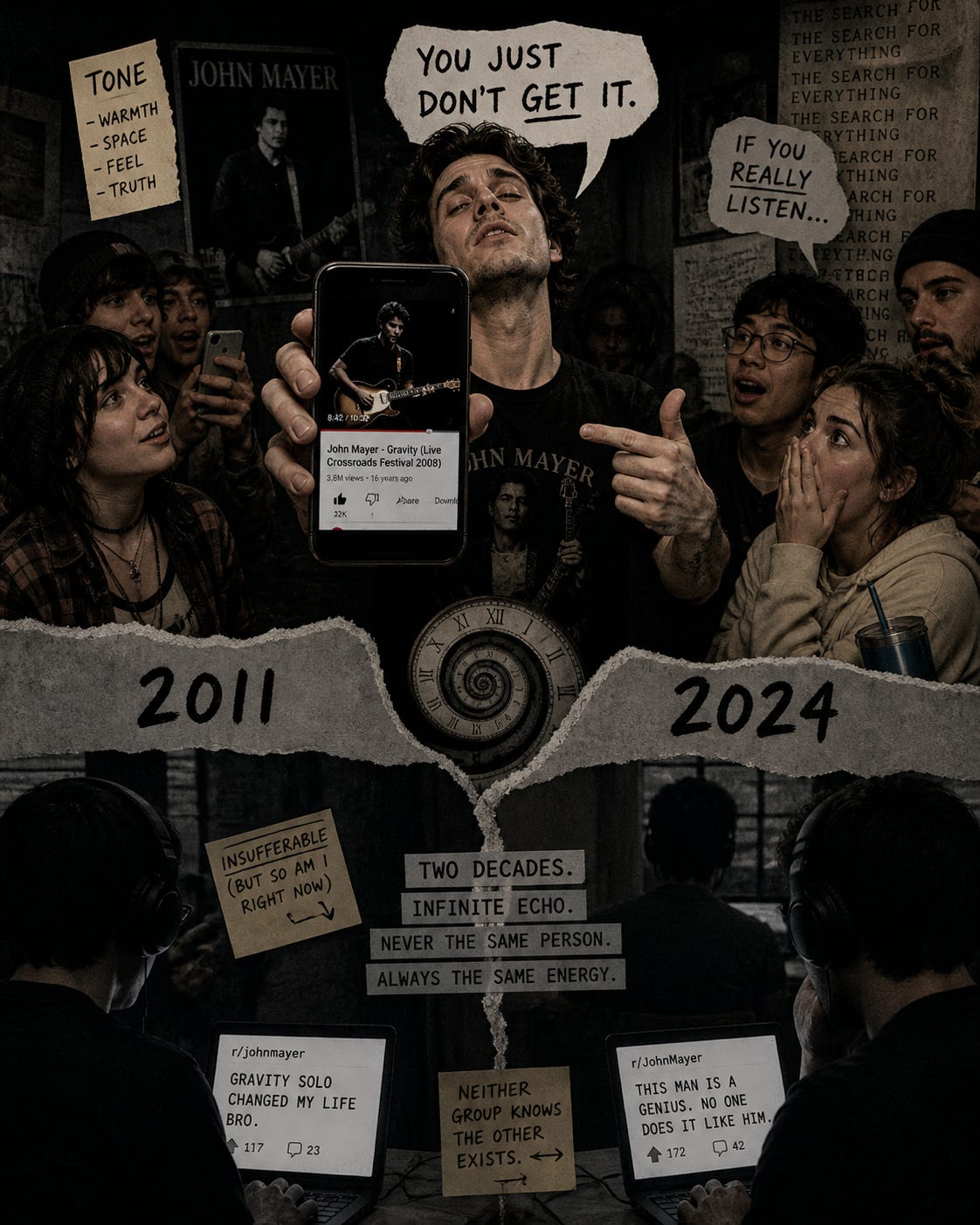
There is a particular kind of person who discovers John Mayer at twenty-three and becomes briefly, completely insufferable about it. They will tell you about his tone. They will forward you a YouTube clip (probably the one from the 2008 Crossroads Festival, the Gravity solo, the one where he bends a note so slowly that time itself seems to pause and reconsider) and they will watch your face for signs of conversion. This has been happening, with near-clockwork regularity, for over two decades. What is remarkable is not that it happens. What is remarkable is that the people doing it in 2011 are entirely different people from the ones doing it in 2024, and neither group is fully aware the other exists.
John Mayer has pulled off something that almost no artist in popular music history has managed cleanly: a complete generational reset. Not a comeback (comebacks imply a fall) but a lateral reinvention so smooth that it reads, in retrospect, as a continuous ascent. He is currently positioned as the spiritual custodian of a certain kind of soulful, serious guitar playing, revered by people who were in elementary school when Continuum came out and by the original cohort who bought it on CD. The architecture behind this positioning is, if you look at it plainly, one of the most sophisticated personal brand operations in the history of popular music. The question worth asking, and it is a genuinely hard question, is how much of it is engineered, and how much of it is just what happens when a person is actually very, very good.
Phase One: The Confessional Pop Trojan Horse
It is easy to forget, if you came to Mayer through the blues, what he was before he was a bluesman. “Your Body Is a Wonderland” won a Grammy in 2003. It is a song about a woman’s body that rhymes “bubblegum tongue” with itself. It is inoffensive, mellifluous, and almost aggressively radio-shaped. It made him famous among people who had no particular interest in guitar playing, and it gave him something invaluable: a commercial platform large enough to fund whatever he actually wanted to do next.
This is the first and least appreciated move in the Mayer playbook. He did not arrive as a blues guitarist and condescend to make a pop record. He arrived as a pop star with a quietly devastating guitar habit that he kept, for a few years, largely to himself. Room for Squares and Heavier Things were mainstream successes. They also contained, if you knew where to look, playing that was not remotely normal for that genre. Most people did not look. That was the point.
“He gave the mainstream something it could hold without flinching, and then waited. The patience required for that, in a business built on quarterly streaming numbers and the attention span of a TikTok scroll, is almost impossible to overstate.”
The move was patient in a way that reads as almost shocking now. He gave the mainstream something it could hold without flinching: polished, emotionally legible singer-songwriter music. And then he waited. Waited until he had enough capital, enough attention, enough goodwill to spend some of it on something riskier. The patience required for that, in a business built on quarterly streaming numbers and the attention span of a TikTok scroll, is almost impossible to overstate.
The Crossroads Moment and the Claiming of a Lineage
In 2004, Eric Clapton invited John Mayer to play at the Crossroads Guitar Festival, a charitable concert organized around the mythology of the blues. The significance of the invitation was not lost on anyone paying attention. Clapton is the most famous living inheritor of a lineage that runs from Robert Johnson through B.B. King and Buddy Guy, a lineage that carries, in guitar culture, the weight that an apostolic succession carries in theology. To be invited to play at Crossroads is to be, in some sense, nominated for consideration.
Mayer did not squander it. His performance there, and at subsequent Crossroads festivals, became the kind of thing that circulates among guitarists the way certain texts circulate among graduate students: not because they are assigned, but because not knowing them marks you as unserious. The Gravity solo, the slow-hand phrasing, the emotional transparency of his vibrato. These were not stylistic affectations. They were genuine, which made them all the more effective as positioning tools. You cannot fake that kind of playing to an audience that has spent its life listening to players who can.
THE LINEAGE PLAY Mayer’s public relationships with B.B. King, Buddy Guy, and Eric Clapton functioned as something close to endorsement from the founding generation. In a culture where provenance matters enormously, where the question “but can he really play?” carries enormous weight, having the elders answer it in the affirmative is not incidental. It is infrastructure.
By the time Continuum arrived in 2006, the operation was complete. The album is, by any serious measure, a great record: a slow, heavy, emotionally intelligent blues-rock album that made almost no compromises for pop accessibility and still sold over a million copies. It is the record where Mayer spent the pop capital he had been accumulating for five years, and the exchange rate was extraordinary. He traded the listeners who wanted another “Daughters” for the listeners who would still be talking about the Trio B sides fifteen years later. The swap felt like a loss in the short term. It was the foundation of everything that came after.
The Second Generation: YouTube, Tone Culture, and the Infinite Clinic
Here is where the story gets genuinely strange, and where the machinery becomes most visible, if you know how to look at it.
Sometime around 2013, a particular type of video began accumulating views on YouTube: John Mayer, in various configurations, playing guitar in ways that the algorithm had not been asked to surface but surfaced anyway, because people kept watching them. Clinic footage. Soundcheck footage. Interview segments where he talked about tone with the precision and obsessiveness of a watchmaker. Gear demonstrations. Fragments of performances that never made it to official channels. A strange, low-lit interview where he explained the concept of “playing with heart” in terms so specific they almost sounded like instructions.
This content (much of it not produced by Mayer, much of it uploaded by fans and guitar channels) did something specific. It introduced him to a generation of guitarists who had been in middle school during the Crossroads era, who knew “Gravity” as a playlist staple rather than a cultural event, and who encountered him not as a pop star with blues credibility but simply as a guitarist. For this cohort, there was no re-evaluation to do. There was no “wait, the ‘Your Body Is a Wonderland’ guy?” cognitive dissonance to manage. He simply arrived, fully formed, as the reference point for a certain kind of playing.
“For a second generation of players, Mayer arrived not as a pop star with blues credibility but simply as a guitarist: fully formed, pre-authenticated, and without the burden of his own earlier pop success.”
What made this possible, and this is the structural point worth dwelling on, is that Mayer had, by this time, developed an extraordinarily sophisticated relationship with the concept of artisanal guitar culture. He talked about gear with the specificity of an enthusiast but the authority of a professional. He had signature instruments (the PRS Silver Sky, the Fender Custom Shop models) that became aspirational objects not just for their playability but for what owning one signified. He spoke, in interviews and social media fragments, about tone as a philosophical question, about the relationship between technical facility and emotional expression, about the dead ends of virtuosity pursued for its own sake. The discourse was calibrated. It was also, to all appearances, sincere.
THE TONE CULTURE ECOSYSTEM The PRS Silver Sky, released in 2018, was not merely a guitar. It was a conversation-starting object: talked about on forums, reviewed obsessively on YouTube, debated in terms of whether it was “worth it,” which is a question that never actually concerns the price. The debate around the guitar kept Mayer’s name, and his particular aesthetic of serious, soulful playing, in constant circulation among exactly the people most likely to be influenced by it.
The Mechanics of Inevitability
The word that keeps coming up, when you talk to guitarists across different age brackets about their relationship with Mayer’s playing, is inevitable. His name tends to surface not as a recommendation but as a discovery: as if the listener arrived at him independently, through their own exploration, rather than being guided there by the accumulated weight of cultural infrastructure. This feeling of personal discovery is, of course, partly real. Good music does find people through genuine resonance. But it is also partly the product of a system that has been built, over twenty years, to make discovery feel inevitable.
The system has several components. The first is content saturation, not in the modern, desperate sense of posting daily for the algorithm, but in the older sense of ensuring that high-quality material exists at every point of entry. The Crossroads performances for the blues curious. The trio recordings for the jazz-adjacent. The Continuum sessions for the rock purists. The acoustic solo performances for the fingerstyle crowd. The gear content for the equipment obsessives. Whatever door you come through, there is something on the other side that is good enough to keep you inside.
The second component is strategic scarcity. Mayer does not tour constantly. He does not release music on a predictable schedule. Periods of relative absence are followed by returns that feel, because of the absence, like events. The 2017 The Search for Everything era, the 2021 Sob Rock album: both arrived into markets that had been waiting, and the waiting had done half the promotional work already. Scarcity is not an accident. It is a structural choice that requires sustained discipline to maintain in an industry that constantly pressures artists toward continuous output.
The third component, and perhaps the most underappreciated, is what might be called the authentication chain. Mayer has maintained, throughout his career, relationships with musicians and figures whose credibility is not contingent on his own. Dead & Company (the continuation of the Grateful Dead’s touring legacy) gave him access to one of the most loyal and culturally specific fanbases in American music, a fanbase that evaluates outsiders with considerable skepticism and accepted him as a genuine participant rather than a guest. The relationships with B.B. King and Buddy Guy, maintained publicly and with evident real affection. The collaborations with Frank Ocean. Each of these functions as a credential, and the credentials accumulate in a way that makes the overall picture feel less like a portfolio and more like a life.
The Genuineness Problem
At some point in any serious analysis of John Mayer, you have to confront a question that the framing of brand strategy tends to dissolve but that actually matters: how much of this is real?
The honest answer, which is also the uncomfortable answer, is: probably most of it. The guitar playing is genuinely exceptional. The knowledge of blues history is demonstrably deep. The obsessiveness about tone is, by all available evidence, not performed. The relationships with older musicians appear to have been genuine. B.B. King’s praise was specific and technical, not the vague endorsement of a legend being photographed with a younger star. The Dead & Company performances, watched by anyone with an interest in improvisational music, reveal a player who understands the idiom from the inside.
What is sophisticated about Mayer’s positioning is not that it is built on a false foundation. It is that a genuine foundation has been architecturally arranged so that it is maximally visible, maximally navigable, and maximally sticky at exactly the moments when people are most likely to form lasting attachments. The talent is real. The distribution of the talent is engineered. And because these two things overlap so completely, it becomes genuinely difficult, perhaps impossible, to separate the artist from the operation.
“The talent is real. The distribution of the talent is engineered. Because these two things overlap so completely, it becomes genuinely difficult, perhaps impossible, to separate the artist from the operation.”
This is different from the standard critique of celebrity self-promotion, which usually involves a performer papering over mediocrity with lifestyle content and access journalism. Mayer is not mediocre. The standard critique does not apply. What applies instead is something stranger and more interesting: the observation that genuine artistry, deployed with sufficient strategic intelligence, produces effects that are indistinguishable from manufactured celebrity, and raises questions that manufactured celebrity never has to answer, because the answers, in Mayer’s case, are too good.
The Timeline of the Reset
2001 – 2005
Pop Platform Phase. Room for Squares and Heavier Things build mainstream reach and commercial capital, largely concealing the depth of guitar playing beneath accessible singer-songwriter surfaces.
2004 – 2008
Blues Authentication. Crossroads Festival invitations, public mentorship from B.B. King and Buddy Guy, and the release of Continuum establish credibility within the blues and rock guitar tradition at the cost of some mainstream reach, a deliberate trade.
2009 – 2013
Crisis and Absence. A period of personal controversy and relative silence that, in retrospect, functioned as a reset of public attention, clearing the field for re-entry on different terms.
2014 – 2020
The Second Generation Conversion. Dead & Company, YouTube algorithm surfacing of archival material, signature instrument releases, and tone-culture discourse recruit an entirely new cohort of guitarists who encounter Mayer without the weight of his pop-star history.
2021 – Present
Sob Rock and beyond. A deliberately ironic engagement with 1980s soft-rock aesthetics, positioned as both genuine exploration and knowing commentary: a move that appeals to the nostalgia of one audience while reading as sophisticated pastiche to another.
What Comes Next
There are signs, if you look at the trajectory, that Mayer may be positioning for a third generational move. The Sob Rock era introduced him to an audience that responds to ironic nostalgia: a Gen Z and younger millennial cohort whose relationship to the 1980s is entirely mediated through cultural archaeology rather than memory. The response to that album suggests the door is open. What he does next, and what new generation of players he manages to convince that whatever he is doing is the most important thing happening, remains to be seen.
What seems unlikely is that the next move will look like the last one. That is perhaps the most reliable thing about Mayer as a strategic operator: the refusal to repeat. Every phase of his career has been legible in hindsight as preparation for the next one, but never predictable in advance. This is the hardest thing to manufacture: the genuine unpredictability that keeps even his detractors paying close attention.
Because this is the strangest part of the whole operation: even people who find the machinery irritating, who bridle at the tone culture and the signature guitars and the carefully managed mystique, tend to keep watching. There is a gravitational pull that persists even through skepticism, which is either the sign of a very good brand or a very good artist. In the case of John Mayer, after twenty-five years, the most honest thing you can say is that it has become impossible to tell the difference, and that this impossibility is itself the achievement.
★