

THE GUITAR DIDN’T GET BETTER. IT JUST SURVIVED LONG ENOUGH TO MATTER.
Why time, tension, and imperfection slowly turn wood, wire, and wear into a voice you can’t replicate.
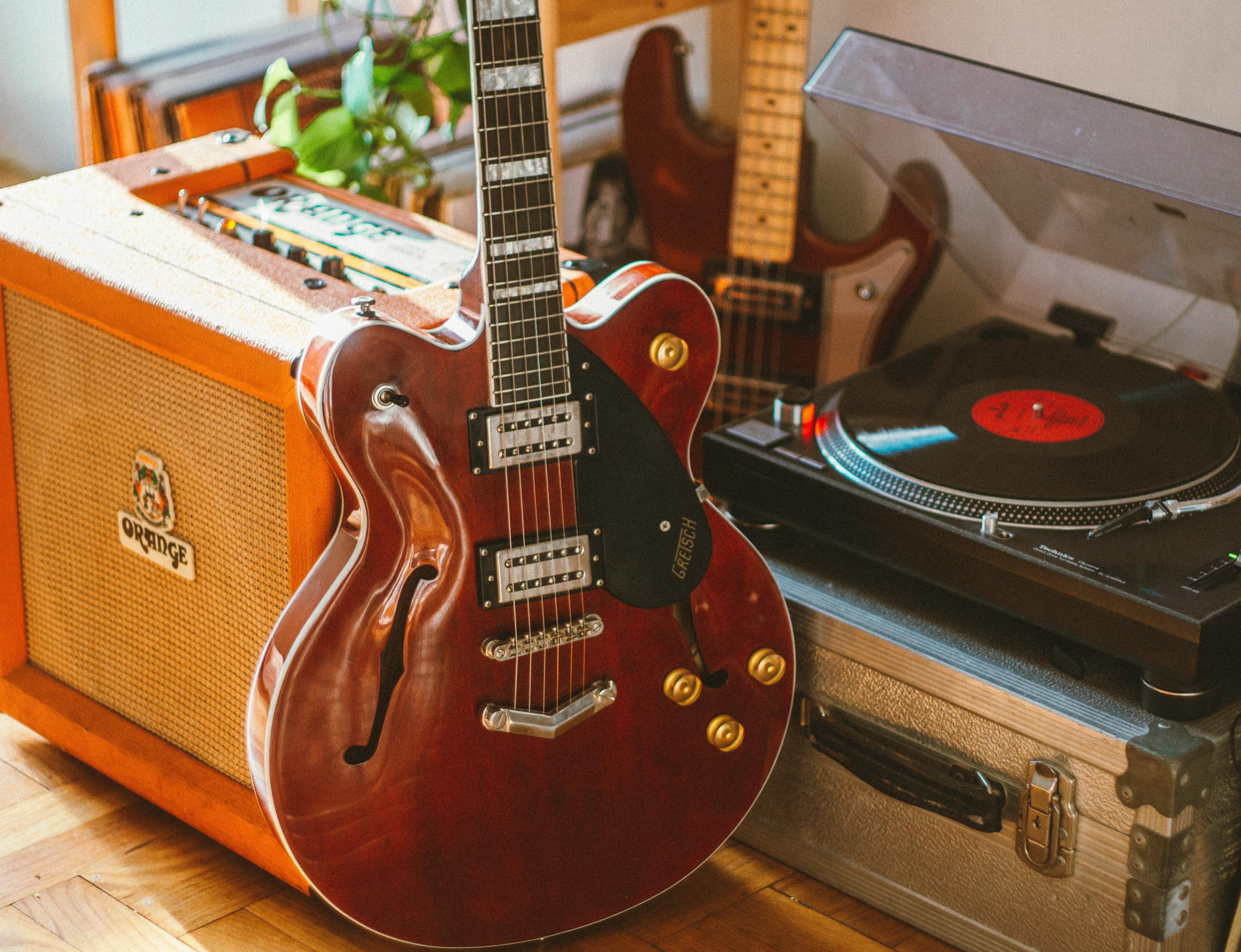
I remember the first time I played a truly old guitar.
Not “used.” Not “broken in.” I mean old. Decades of tension. Decades of vibration. Decades of being held, sweated on, tuned, detuned, pushed, and sometimes neglected. The kind of instrument that feels like it’s already speaking before you even touch it.
And the first thought that hit me wasn’t technical.
It was simple:
Why does this feel alive?
As a guitarist and someone who has spent years thinking analytically about systems, inputs, and outputs, I couldn’t just accept the romantic answer. I needed to understand the mechanics behind it.
Because if we can understand why aging affects tone, we can stop chasing myths and start recognizing what actually matters.
The Simplified Truth
Aging doesn’t magically “improve” a guitar.
It changes the material properties of the instrument over time, and those changes influence how energy moves through it.
That’s it.
But inside that simple statement is where things get interesting.
Wood Is Not Static, It’s a Living Record
The biggest factor in vintage guitar tone is wood.
Not just the species, but what time does to it.
When a guitar is built, the wood still contains:
Residual moisture
Organic resins
Internal stress from cutting and shaping
Over time, several things happen:
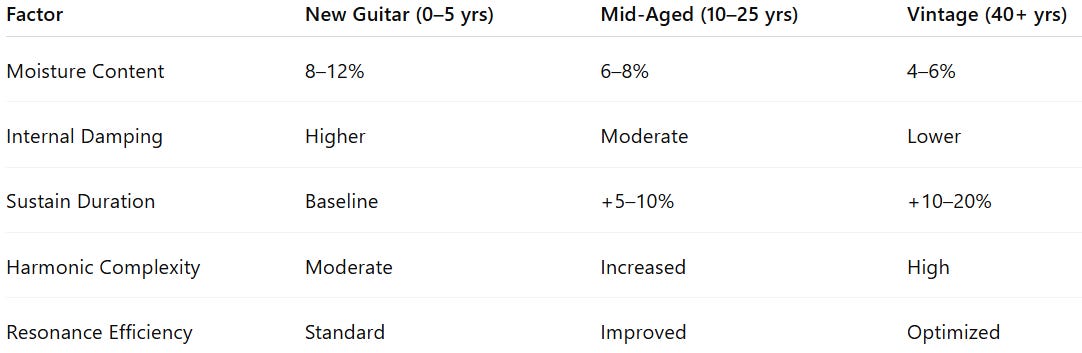
Moisture Content Stabilizes
Wood slowly dries and equalizes with its environment.Cellular Structure Crystallizes
Resins harden. Fibers become more rigid.Mass Slightly Decreases
Microscopic material loss occurs over decades.Stiffness-to-Weight Ratio Improves
This is the key.
As stiffness increases while mass slightly decreases, the wood becomes more efficient at transmitting vibration.
That’s where the tonal shift begins.
The Physics of It (Without the Overcomplication)
Tone is energy.
When you pluck a string, that energy transfers into the guitar body and neck.
The question is:
How efficiently does the instrument move that energy?
Younger wood tends to:
Absorb more energy
Dampen vibrations faster
Produce a tighter, sometimes more compressed sound
Aged wood tends to:
Transfer energy more efficiently
Sustain vibration longer
Emphasize harmonic complexity
This is why older guitars are often described as:
“Open”
“Resonant”
“Breathing”
Those aren’t just poetic terms…they’re observations of physical behavior.
The Vibration Effect: Time + Playing = Transformation
Here’s where things shift from passive aging to active evolution.
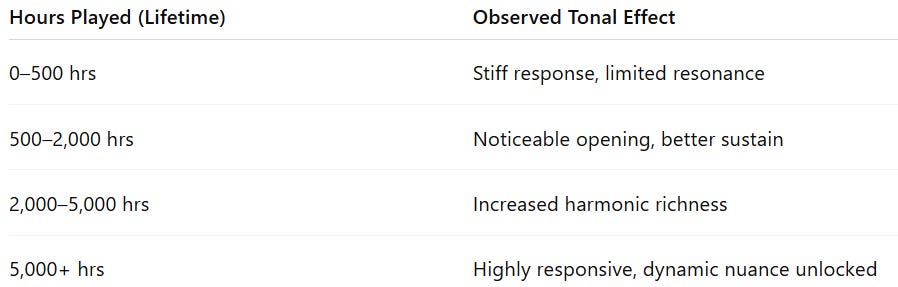
Guitars don’t just age, they are played into shape.
Every note you play sends vibrations through the instrument.
Over years and decades, this does something subtle but powerful:
It trains the wood fibers to resonate more freely at musical frequencies.
Think of it like this:
Unplayed guitar = stiff system
Frequently played guitar = conditioned system
There’s a reason two identical guitars from the same year can sound completely different.
One lived in a case.
The other lived in someone’s hands.
Hardware Aging: The Overlooked Layer
It’s not just wood.
Metal components also evolve:
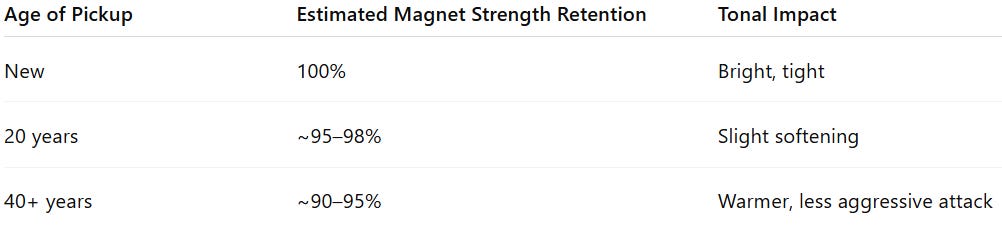
Pickups can lose a small percentage of magnet strength
Potentiometers wear and change resistance behavior
Bridges and saddles settle into micro-contact points
These changes are subtle, but they contribute to:
Slightly softer attack
Smoother high-end response
Less aggressive transient peaks
Again, not better.
Just different.
But those differences stack.
Finish Breakdown: The Hidden Contributor
Vintage guitars often have thinner or degraded finishes compared to modern ones.
Why does that matter?
Finish acts as a barrier to vibration.
Over time:
Nitrocellulose finishes crack and thin
Micro-fractures reduce damping
The wood becomes more “exposed” to vibration
This leads to:
Increased resonance
Faster response
More dynamic sensitivity
It’s one of the most underrated aspects of vintage tone.
The Numbers Behind the Feel
Let’s step out of the subjective for a moment and look at measurable trends.
Wood Aging vs Acoustic Response
Playing Time vs Tonal Development
Pickup Aging (Magnetic Flux Change)
The Myth Layer (And Why It Matters)
There’s a narrative that vintage guitars are automatically better.
That’s not true.
What’s true is this:
Aging introduces variance
Some guitars evolve into something special
Others don’t
Time is not a guarantee.
It’s a filter.
My Experience as a Player and Analyst
Coming from both music and finance, I see vintage guitars the same way I see long-term assets.
Not everything appreciates.
But the conditions that lead to appreciation are consistent.
When I’ve played older guitars that felt incredible, they almost always shared:
Consistent use over time
Stable environmental conditions
Minimal structural damage
High-quality original materials
That combination matters more than age alone.
The Correlation That Most Players Miss
Here’s the real insight:
Tone is not just about age…it’s about history under tension.
Let’s break that down.
Tone Development Correlation Model
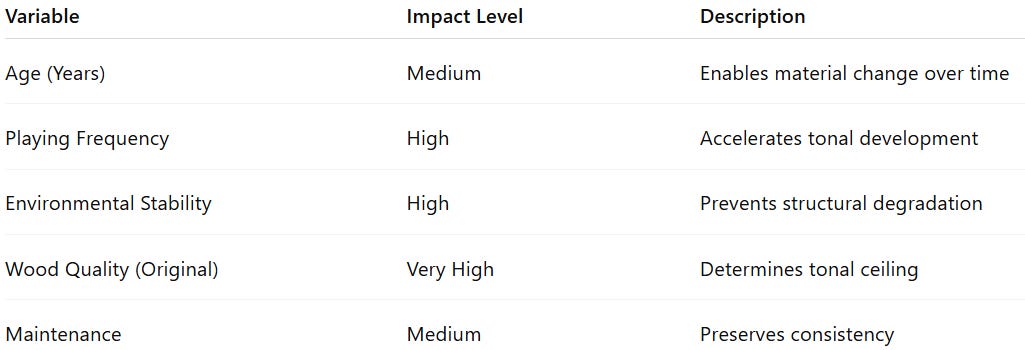
If you’re chasing vintage tone, age alone is the weakest variable.
That’s the part most people don’t want to hear.
The Emotional Side (Because It Matters)
There’s also something else happening.
And we can’t ignore it.
When you pick up an older guitar, you’re not just hearing tone.
You’re feeling:
The wear in the fretboard
The softened edges
The subtle imperfections
Your brain interprets that as character.
That influences how you play.
Which influences how the guitar sounds.
So part of “vintage tone” is actually player response.
And that’s real…even if it’s not measurable.
If you’ve been chasing tone through gear upgrades, here’s the uncomfortable truth:
You might be skipping the most important variable.
Time + use.
Not passive time.
Active time.
The kind you don’t post.
The kind no one sees.
The kind that slowly changes both you and the instrument.

Instead of asking:
“What vintage guitar should I buy?”
Ask:
“What relationship am I building with the guitar I already have?”
Because here’s what I’ve learned:
The guitars we admire today didn’t become great overnight.
They became great because someone stayed with them long enough to let them evolve.
Final Thought
Vintage tone isn’t a product.
It’s a byproduct.
Of time.
Of tension.
Of repetition.
Of care.
And most importantly!
Of someone deciding not to quit on the instrument before it had time to speak.
If you stay long enough…
Your guitar might not just sound better.
It might start sounding like you.