

The Guitarist Who Broke the Instrument and Rebuilt It
How Eddie Van Halen turned curiosity, experimentation, and raw imagination into a revolution that permanently changed the sound of rock guitar. 🎸
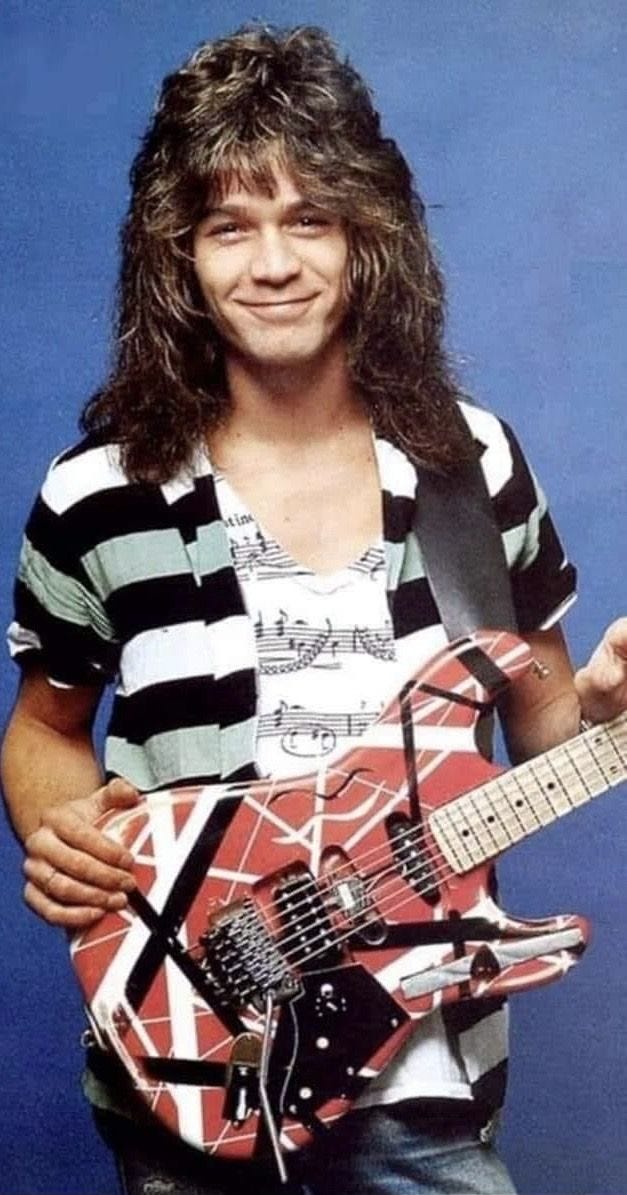
Let me ask you something.
When the conversation turns to the most transformative guitarists in rock history, there’s usually a moment when the direction shifts. Someone inevitably brings up Eddie Van Halen, and suddenly the discussion isn’t just about great players anymore, it’s about a turning point.
For those of us who grew up listening to him, the respect almost feels automatic. But if you step back and really think about it, the impact is still a little hard to wrap your head around. How does one guitarist change the trajectory of an instrument so dramatically that decades later we’re still hearing the aftershocks in modern rock guitar?
Eddie wasn’t just fast. And he wasn’t just technically impressive.
He rewrote the language of the electric guitar.
Before Eddie showed up, most rock guitar vocabulary came straight out of the blues. Players leaned heavily on familiar phrasing, pentatonic ideas, and traditional rock structures. It worked—and there were incredible players doing amazing things within that framework.
Then 1978 happened.
The debut record from Van Halen arrived, and it felt less like a new album and more like a controlled detonation inside the guitar world. Suddenly the instrument sounded different. The energy felt different. Even the possibilities felt different.
That record didn’t just introduce a band.
It shifted the center of gravity for guitar players everywhere.
And right in the middle of that shift was Eddie.
What made it so powerful wasn’t just flash or spectacle. Plenty of guitarists could play fast or loud. Eddie was chasing something deeper. He was experimenting, tinkering, listening for sounds he hadn’t heard yet.
In other words, this wasn’t about showing off.
It was curiosity… turned into electricity.
The Mind of a Musical Experimenter
Born in the Netherlands and raised in Southern California, Eddie grew up in a household filled with classical music. His father, a professional musician, exposed him and his brother Alex Van Halen to piano and orchestral composition long before rock music entered the picture.
That classical discipline quietly shaped Eddie’s thinking. He didn’t approach the guitar as a finished instrument. He approached it like an inventor approaches a machine that can still be improved.
He rewired guitars.
He modified amplifiers.
He experimented endlessly with tone.
What emerged from that experimentation was something revolutionary: two-handed tapping. While the technique had existed in fragments before, Eddie transformed it into a musical statement. His instrumental piece Eruption became a rite of passage for generations of guitarists.
But the real story isn’t speed.
It’s imagination.
Guitar Breakdown: Engineering a New Sound
Below is a focused breakdown of the elements that made Eddie’s playing so distinctive:
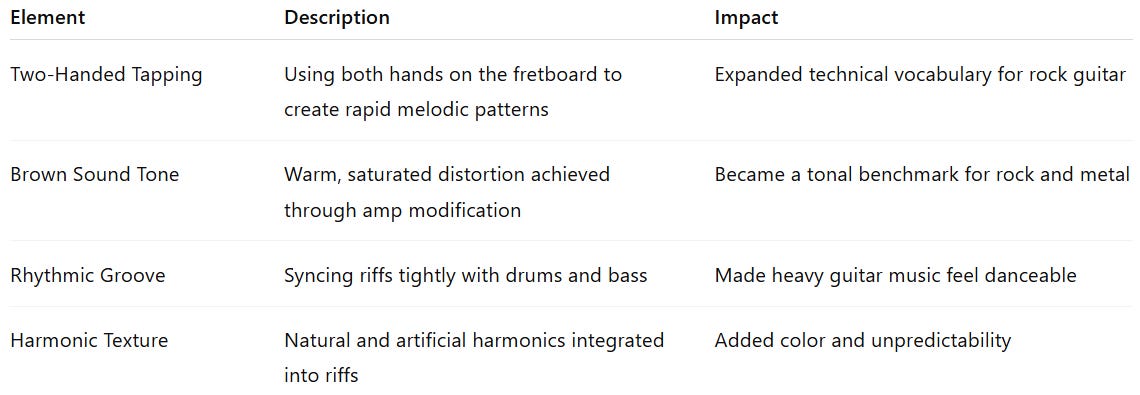
This is a masterclass in innovation through curiosity. Eddie didn’t chase technical difficulty simply to impress other musicians. He chased sounds he hadn’t heard before.
And once he discovered them, he built entire songs around those discoveries.
Groove Inside the Fire
Listen closely to classics like Panama or Ain’t Talkin’ ‘Bout Love and something becomes clear: beneath the fireworks is groove.
Eddie’s riffs swing.
They breathe.
Unlike many guitar heroes who dominated the sonic space, Eddie played with the band rather than above it. His interplay with Alex’s drumming created a rhythmic engine that made the music feel explosive but controlled.
For guitarists, this is a lesson that often gets missed:
Speed impresses musicians.
Groove moves people.
The Human Side of a Guitar Legend
Offstage, Eddie was widely known as both humble and restless. Friends and collaborators often described him as someone who never stopped tinkering. Even at the height of fame, he spent countless hours in his studio chasing better tone, smoother mechanics, or new sounds.
Like many artists who burn brightly, he also battled personal struggles, including health issues and addiction. But through those challenges, his devotion to music remained constant.
Eddie once said he didn’t consider himself a virtuoso. He simply played what he heard in his head.
That honesty defined him.
The Legacy Argument
If legacy is measured by influence, Eddie Van Halen stands among the most consequential guitarists who ever lived. Entire generations of players from hard rock and metal to modern progressive guitar and trace their lineage back to his innovations.
The techniques he popularized became standard vocabulary.
The tones he pioneered became industry targets.
And the spirit of experimentation he embodied continues to inspire players to push the instrument forward.
The Guitarist’s Takeaway
For players studying Eddie’s approach:
Experiment with your gear instead of accepting factory settings.
Practice rhythm as intensely as lead technique.
Study tone shaping as part of musicianship.
Ask yourself: What sound hasn’t been discovered yet?
Eddie Van Halen proved something essential about creativity.
Innovation doesn’t come from perfection.
It comes from curiosity.
And in that sense, Eddie didn’t just play the guitar.
He reinvented it.
Leave a comment 🎸