Why Reading Still Wins
What it actually does for your brain, your mood, and your life

Lundinke Leisure & Lifestyle
A few weeks back I had to pick up my mother’s prescriptions. The pharmacy had that slow, no-schedule kind of wait where you just sit until they call your name. I grabbed a chair, pulled a book out of my bag, and started reading.
I looked up at one point and noticed something. Everyone else in that waiting room had a phone out. Not really reading anything. Just scrolling, that glassy, half-there look on their faces, thumbs moving on their own. And there I was with an actual book in my hands, fully in it.
I felt something I hadn’t felt in a long time. Not better than anyone else in that room, just… full. Present. Like I was doing something for myself instead of just killing time. I sat there beaming, and I’m not exaggerating that word. I haven’t forgotten that feeling. I carry a book with me everywhere now.
That fifteen minutes in a pharmacy waiting room taught me more about what reading actually does than any article ever has. So here’s what’s actually happening when you trade the scroll for the page, backed by what the research and the numbers say.
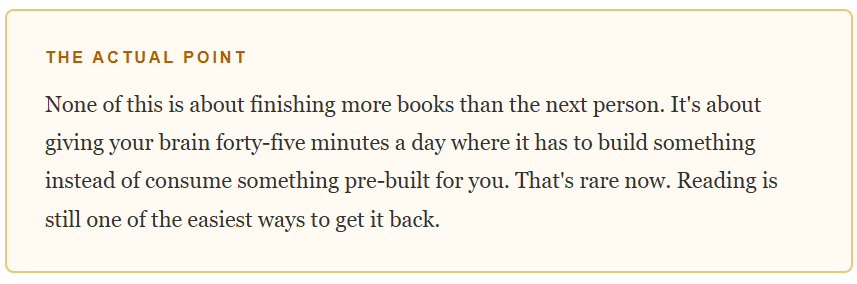
Pick up a book tonight instead of your phone, and here’s what happens in your head: your brain has to build the whole scene from scratch. The room, the faces, the tension in someone’s voice. No screen is doing that work for you. That’s the whole case for reading in one sentence: it’s one of the few habits left that makes your brain do the heavy lifting, and it pays you back for the effort.
Your brain on books
Reading is closer to a workout than a pastime. You’re holding character names, plot threads, and unanswered questions in your head all at once, then connecting them as you go. That’s a real cognitive load, and your brain adapts to it the same way a muscle adapts to resistance: memory improves, focus stretches longer, and the wiring that handles language and reasoning gets reinforced. Researchers have linked regular reading in later life to a slower rate of cognitive decline, which is one more reason to treat it as routine maintenance, not a luxury.
Where your imagination actually gets exercised
A book hands you a setting and a voice and asks you to build the rest. That’s different from watching a show, where every visual choice has already been made for you. Fiction in particular puts you inside heads that aren’t yours: a different era, a different set of values, a different way of solving a problem. That mental rehearsal carries over. People who read regularly tend to generate more original solutions and hold onto more than one way of looking at a problem, because they’ve spent hours doing exactly that on the page.
The empathy effect is real
Spend three hundred pages inside someone else’s head and you come out the other side understanding people a little better, including the ones who don’t think like you. Researchers studying “narrative transportation” (the feeling of being pulled into a story) have found it’s connected to higher empathy and a better read on other people’s emotions. Fiction in particular seems to do this: when you’re tracking a character’s choices and consequences, you’re quietly practicing the same skill you use to read the people in your own life.
One of the few screen-free ways to actually slow down
A book doesn’t notify you, autoplay the next thing, or reward you for staying longer. You set the pace. That alone makes it one of the simplest ways to lower your stress level and give your attention a rest. Plenty of people already use it that way: relaxation is the single biggest reason Americans say they read.
Vocabulary and knowledge compound
Every book you finish adds something: a fact, a phrase, a way of framing an idea you didn’t have before. None of it shows up overnight. But two years from now, the person who read forty books and the person who didn’t will not sound the same in a conversation, and it won’t be close.
READING BY THE NUMBERS (2025–2026)
The picture has shifted since the last time anyone wrote about this, so here’s where things actually stand:
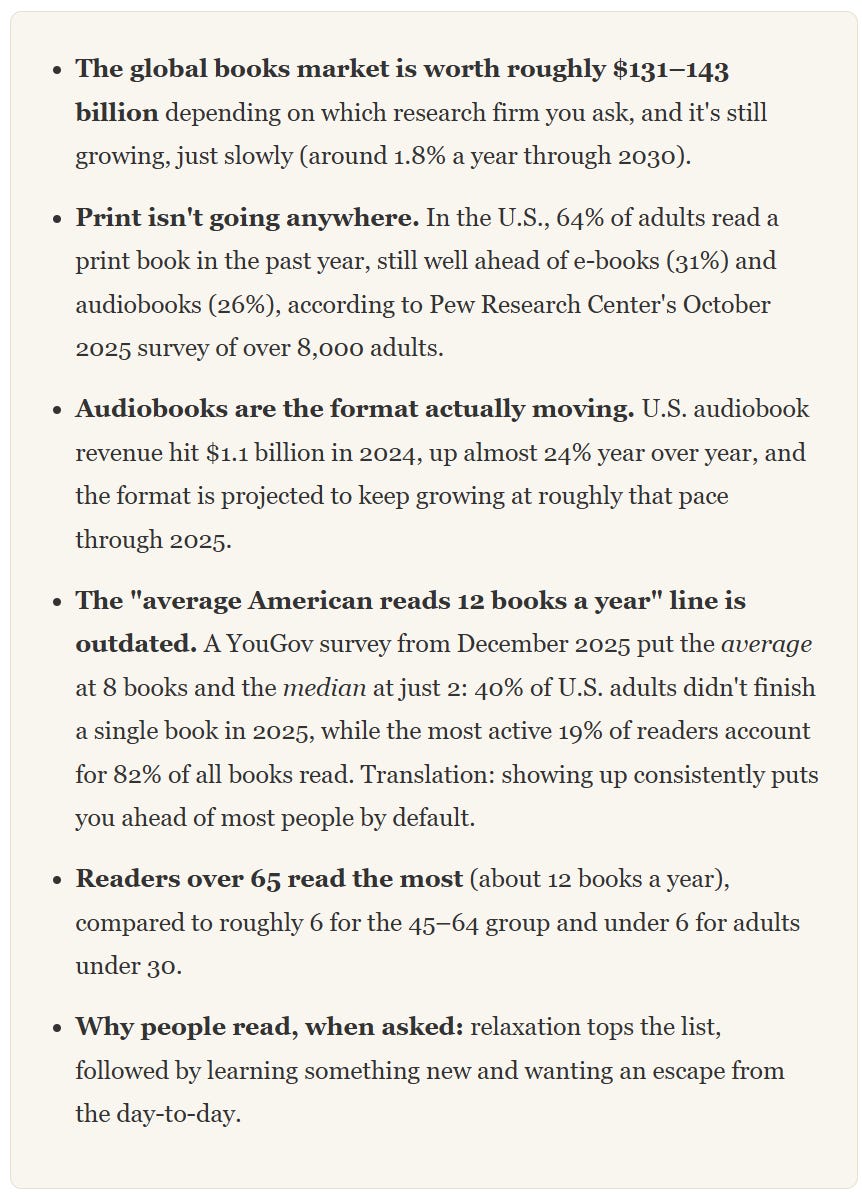
If you read even one book a month this year, you'd already be ahead of 80% of the country. That's not a high bar. It's just one most people have stopped clearing.

5 BOOKS WORTH STARTING WITH
Not a “must-read” list. Just five that earn their place on a shelf, picked across genres so there’s an entry point no matter what you’re into.
“How to Read a Book” by Mortimer J. Adler and Charles Van Doren: An old book about reading better books. Sounds dry, isn’t. It’ll change how you take notes and what you actually remember six months later.
“A Gentleman in Moscow” by Amor Towles: Fiction, and an easy one to fall into. A Russian count is sentenced to house arrest in a hotel for the rest of his life, and somehow that becomes one of the warmest stories you’ll read this year.
“The Storytelling Animal” by Jonathan Gottschall: A short, sharp look at why humans can’t stop telling and consuming stories, and what that says about how your brain is wired. Pairs well with the empathy point above.
“Atomic Habits” by James Clear: If you want the practical end of this list: a clear, no-fluff breakdown of how small, repeatable actions (like, say, reading ten pages a night) compound into real change.
“Deep Work” by Cal Newport: Makes the case for sustained, undistracted focus as a skill you can build, and reading is one of the best tools for building it. Useful whether your distraction problem is your phone, your inbox, or both.

5 SMALL HABITS THAT MAKE READING STICK
1. Set a number, not a vibe. “Ten pages a night” beats “I should read more.” Specific goals get finished; vague ones get postponed. Track it in something simple like Goodreads or a Notes app so you can see the streak build.
2. Match the format to the moment. Print at home, audiobook in the car, e-book in the waiting room. Apps like Libby let you borrow e-books and audiobooks free through your local library, no extra subscription required.
3. Read what actually pulls you in. Skip the “best books of all time” list if nothing on it interests you. Read the first chapter before committing. If it’s not grabbing you by page 30, put it down. Life’s short and there are 2.2 million new titles published every year. One of them is for you.
4. Stack it onto something you already do. Coffee in the morning, the last twenty minutes before bed, the bus ride to work. The habit sticks when it rides on the back of a habit you’ve already built, not when it’s one more thing competing for a slot in your day.
5. Write down one thing per book. A line that hit you, an idea you want to try, a question the book raised. You don’t need a full reading journal (though Kindle’s highlight feature or an app like Evernote makes it painless). You just need one sentence that proves the book left a mark.