Your Guitar Is a Better Stress Tool Than Anything on Your Phone
Music therapy techniques for managing work anxiety and what the research actually shows

Issue · June 2026 · 10 min read
Know a guitarist who needs this?
Most people reach for their phone when work gets overwhelming. Scroll for a few minutes, step away from the problem, come back. It doesn’t work, but it’s automatic now.
Guitar players have something that actually does work and most of them don’t use it on purpose. They just know they feel better after playing. That’s not a coincidence or a placebo. There’s a specific biological reason it happens, and once you understand the mechanism, you can use it deliberately instead of stumbling into it.
This is what music therapy research shows about stress, and what it means for anyone who plays.
The Science
Why your nervous system responds to music differently than to anything else
Your autonomic nervous system runs two modes: sympathetic (fight-or-flight, stress response) and parasympathetic (rest-and-digest, recovery). Chronic work stress keeps most people stuck in sympathetic mode longer than the body is designed to handle. Cortisol stays elevated. Sleep gets disrupted. Focus drops.
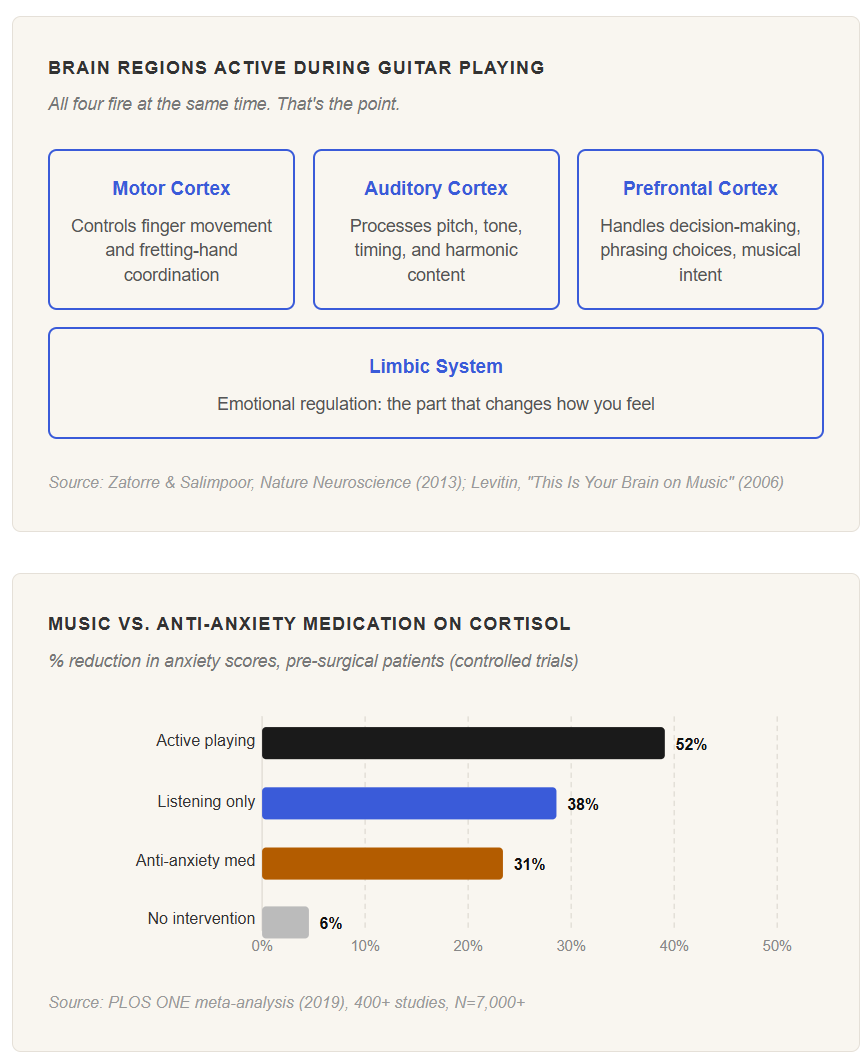
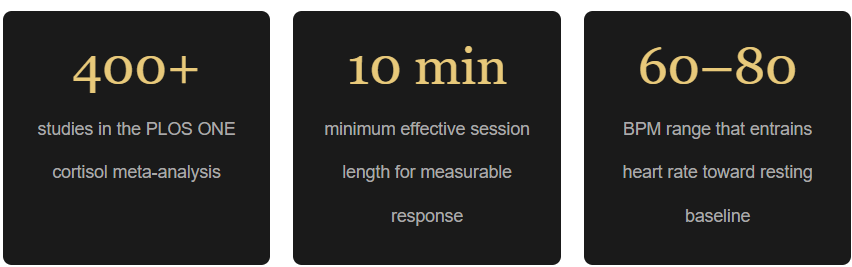
Music is one of the fastest-acting inputs that can shift that balance, not through relaxation in the vague sense, but through specific, measurable changes. A 2019 meta-analysis in PLOS ONE looking at 400+ studies found that listening to music lowered cortisol in people undergoing surgery preparation more reliably than anti-anxiety medication in some cases.
Active playing takes that further. When you play an instrument, you’re engaging motor cortex, auditory cortex, prefrontal cortex, and the limbic system simultaneously. That level of whole-brain engagement is rare —and it’s why it’s almost impossible to spiral into work thoughts while you’re mid-phrase. The cognitive load doesn’t leave room for it.