
Your Music Didn't Burn You Out. You Did.
What no one tells established musicians about the slow, quiet cost of building a career on the thing you love most. Lundinke Growth Mindset Course Workbook at the end.
The Instrument I Almost Forgot I Was Playing
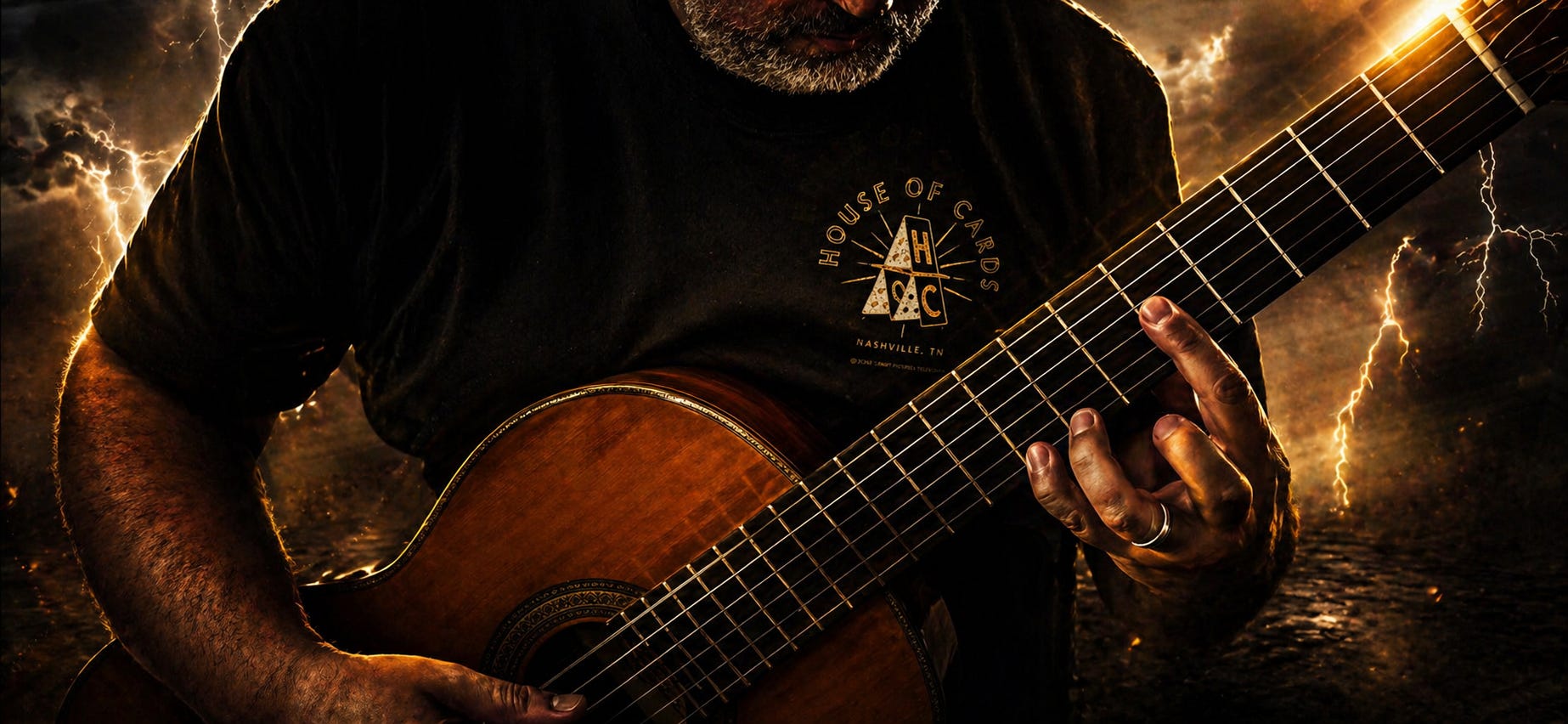
There is a moment I keep coming back to, and I have turned it over in my mind enough times now that I can describe it with the kind of precision that only comes from obsessive revisiting. I was sitting in front of my guitar, the one that has been in my living room for over fifteen years, the one with uneven frets that I have never gotten around to fixing, and I just stopped. Well, that and life happened. And I realized, sitting there in the quiet, that I could not remember the last time I had played something purely because I wanted to.
I sat there for a long time that night, and it frightened me in a way that no bad performance ever had. Because this was not a crisis of skill or technique. My hands still knew where to go. What I had lost, quietly and gradually, in the way that you lose things you never think to protect because you assume they will always be there, was the relationship. The one between me and the music. The one that had started everything in the first place.
When the Thing You Love Starts to Feel Like a Job, You Have Already Lost Something Important
If you have been playing for a long time, you probably understand what I mean when I say that music and identity get tangled up in each other in ways that are genuinely difficult to separate. At some point in a musician’s life, the music stops being something you do and becomes something you are, which is a beautiful thing, honestly, until it isn’t. Because when the music starts to feel like work, when it starts to carry the weight of obligation rather than desire, it does not just affect your career or your output or your creative momentum. It reaches further than that. It affects how you understand yourself, how you move through the world, what you think you are worth on the days when the sessions are hard and the inspiration refuses to show up.
That is the thing nobody warns you about at the beginning, when the whole endeavor feels so pure and straightforward.
When you are starting out, the hunger has a kind of cleanliness to it that I have been chasing ever since. You practice because you are genuinely obsessed, because the sound is pulling you forward and there is no resistance in you worth mentioning. You stay up too late and skip things you probably should not skip because the music feels more urgent than almost everything else, and that urgency is not exhausting yet because it is also what makes you feel most alive. Identity and passion are in complete alignment. You are what you love, and loving it costs you nothing.
But years pass, and gigs accumulate, and your skills sharpen into something that other people start to depend on, and slowly something shifts in a direction you did not choose and might not have noticed until it was already well underway. The music that once pulled you forward begins, on certain days, to feel like it is pushing. There are deadlines and expectations, other people’s but somehow more brutally your own, and a catalog of work behind you that you feel obligated to both honor and evolve simultaneously. The instrument that used to be the place you ran to when the rest of life felt heavy becomes, on the hardest days, just one more demand in a life that already has plenty of them.
And you do not talk about this. You do not talk about it because you are established, because people around you assume you have it figured out, because there is a particular kind of silence that settles over musicians who have been at this long enough that admitting struggle feels like ingratitude, or weakness, or a confession you cannot take back once it is out in the world. So you keep showing up, and you keep playing, and you keep producing things that are good enough that no one on the outside would ever suspect anything was wrong. And gradually, without any single dramatic event to point to, you hollow out a little.
The Cure Is Not More Discipline. It Is Playing Badly on Purpose.
I did not fix this overnight, and I want to be honest about that because I have read enough essays that move too quickly toward resolution, and I have never fully trusted the ones that do.
What I started doing, slowly and imperfectly and with no real strategy at first, was drawing a line. Not between music and the rest of my life exactly, but between music as output and music as experience. I started protecting small pockets of time where I played with no agenda at all, no recording running in the background, no goals I was working toward, no imagined audience filtering what came out. Just the instrument and me and whatever happened to emerge from that combination on any given evening.
Some of those sessions were genuinely bad in the most liberating way possible, meandering and shapeless and nothing I would ever want another person to hear. And that, it turned out, was entirely the point.
Because what I was doing in those sessions was not practicing, not in any conventional sense of the word. I was remembering. I was trying to remember what it felt like to play before anyone was listening, before a recognizable sound that people had come to expect from me, before any of the external architecture of a career had been built up around the simple fact of me and an instrument in a room together. I was trying to locate the version of myself who had picked up the instrument before any of this mattered, and I was trying to just sit with him for a while without agenda.
It felt fragile and almost embarrassing at first, like attempting to be a beginner when you are clearly not one and have not been for a very long time. But there is something waiting on the other side of that awkwardness that I do not have a single clean word for. Renewal is close. Reorientation is maybe closer. The particular relief of discovering that you are still in there, underneath everything you have built, and that the building has not buried you entirely.
You Are Not Your Music, and Believing Otherwise Will Eventually Break You
Here is something I have come to believe, and you are welcome to disagree with it: the musician is not the music. The music is something the musician makes, something that comes through you and that you shape and are shaped by in return, and that distinction, as small as it might sound when you first encounter it, turns out to matter enormously when it comes to sustaining yourself over the long arc of a creative life.
Because if you are the music, then a bad session is an attack on your identity. A period of creative drought becomes something close to an existential crisis. Changing your sound or evolving your approach feels like erasing the person you used to be rather than simply growing beyond a version of yourself that had run its course. Every moment of self-doubt becomes a verdict not just on your work but on your fundamental worth as a human being.
But if the music is something you make, something you bring yourself to and that requires you to show up but does not require you to disappear inside it, then you can have a difficult month without losing yourself in the process. You can change direction without it feeling like betrayal. You can be a complete and complicated human being with a life outside the studio and needs that have nothing to do with creativity, and none of that has to be framed as a failure of commitment or a sign that you care less than you used to.
The instrument does not define you. You bring yourself to the instrument. And the self you bring matters more than most of us in this life are ever encouraged to believe.
Balance Is Not a Soft Word. It Is the Most Demanding Practice You Will Ever Commit To.
Balance used to be a word I had very little patience for because it sounded to me like compromise, like agreeing to be mediocre at everything so that nothing could hurt you too badly. I have changed my mind about this, gradually and somewhat reluctantly.
Balance for a musician, I now think, is not about playing less or caring less or turning down the volume on the thing that has always mattered most to you. It is about building a life that can actually sustain the playing over time, a life that protects the parts of yourself that feed the music rather than consuming them entirely in service of output. It means having relationships and friendships that exist completely outside the industry, that would survive even if you never played another note. It means reading and walking and cooking and being genuinely, productively bored sometimes, because boredom is where curiosity lives when it is not performing for anyone. It means allowing yourself to be a person who plays music rather than a musician who occasionally, guiltily, remembers that they are also a person.
That sounds straightforward when I write it out like this, but I want to be clear that it is not. It requires deliberate, repeated, sometimes uncomfortable choice, especially when the work is compelling and the opportunities are real and the voice in your head, the one that sounds so much like discipline and dedication, is telling you that you should always be doing more.
But I come back to that night staring at the guitar. I come back to my hands on the frets and the silence after I stopped playing and the particular quality of fear I felt sitting in that silence. And I know, with a certainty I have rarely felt about anything, that I do not want to return to that place.
This Is Not a Problem You Solve. It Is a Practice You Return To.
I am still working this out, and I think it is important to say that clearly before the end. There are weeks when I fall back into the old patterns, when everything becomes about the work and I surface one afternoon to realize that I have not played freely in longer than I care to admit, and I have to make the choice to begin again.
But I have started to think that is acceptable. That the practice of returning to yourself, of choosing it again after you have drifted, is its own kind of discipline and maybe not so different from the instrument itself. You do not arrive at it once and stay there without effort. You have to keep showing up, keep choosing it, keep being willing to sit down with no plan and no audience and no purpose beyond remembering why any of this started in the first place.
The music will always be there. The work of making sure you are still there to play it is a different kind of practice, and it matters just as much.
Lundinke Mindset Growth Workbook


