

Your Symptoms Aren't the Problem. They're a Message You Keep Ignoring
Why treating the headache and ignoring what caused it keeps you stuck in the same loop

LUNDINKE OFF THE FRETBOARD
You wake up with a headache. You take something for it, and twenty minutes later you’re back at your desk like nothing happened. The headache is gone. The thing that caused it is still sitting there, untouched, waiting to show up again next week as something else: a stomach issue, bad sleep, a short fuse with your partner.
That’s the model most of us run on without ever choosing it. Something hurts, you make the hurting stop, you move on. It works often enough that we never stop to ask what we’re actually doing: treating the smoke alarm instead of the fire.
There’s a different way to look at health, and it’s not new age, not a wellness trend, and not about quitting your doctor. It’s about noticing that your body, mind, and life are one connected system, and that most of what we call “symptoms” are actually that system telling you something specific. Here’s what that looks like in practice, and why it matters more than the headline makes it sound.
By the end of this issue, you’ll have
A clearer way to read what your body is actually telling you when something feels off
Five areas of life that quietly shape your health, in order of how often people overlook them
A handful of small, specific changes you can start today, no overhaul required
THE IDEA
The connection most people miss
Here’s something that should be obvious and somehow isn’t: your body doesn’t run five separate systems. It runs one. Stress isn’t “a mental thing” that stays in your head. It shows up as a tight jaw, a knotted stomach, blood pressure that creeps up over months until a doctor flags it as a number on a chart, disconnected from the thing that actually caused it.
Run that in reverse and the same thing is true. A bad night’s sleep doesn’t just leave you tired. It changes your mood, your appetite, your patience, your decision-making the next day. None of these are separate problems with separate fixes. They’re one system, talking to itself, and most of us only ever hear the loudest part of the conversation.
Instead of asking “how do I make this symptom go away,” start asking “what is this symptom connected to, and what would actually change if I addressed that instead.”
WHAT ACTUALLY RUNS THE SHOW
The five areas no one mentions when they tell you to “be healthier”
When people talk about getting healthy, they usually mean one thing: diet and exercise. Those matter. They’re also a fraction of the picture. Here are the five areas that quietly run the show, roughly in the order people tend to ignore them.

No. 1
Your body, beyond the gym
Yes, food and movement matter. But so does sleep, and most people treat sleep as the thing they sacrifice first when life gets busy, not the thing that determines how well everything else functions. Seven to nine hours isn’t a luxury number. It’s closer to the minimum your body needs to repair itself, regulate hormones, and keep your immune system working the way it’s supposed to. If you’re cutting that corner regularly, that’s very likely where to look first, before anything else on this list.
No. 2
What’s actually going on in your head
Chronic stress isn’t a personality trait or an inevitability of modern life. It’s a physical state with physical consequences: elevated cortisol, disrupted digestion, weakened immunity, and a nervous system that never fully powers down. The fix isn’t “relax more” as a vague suggestion. It’s specific: naming what’s actually stressing you out, talking to someone about it (a friend, a therapist, doesn’t matter who, just someone), and building in moments during the day where your nervous system gets to downshift. Even five minutes of slow, deliberate breathing does something measurable here. It’s not a cure-all. It’s a start.

No. 5
The space you actually live in
This is the one people think about least, and it shapes more than they realize. The cleaning products under your sink, the air quality in your home, how much natural light you get, whether your space feels calm or chaotic when you walk in the door: all of it adds up. You don’t need to overhaul your life to address this. Small swaps (fewer harsh chemicals, more plants, a decluttered corner that’s actually yours) compound over time in ways that are easy to underestimate.
A WORD OF SKEPTICISM
Why this gets dismissed, and why some of the dismissal is fair
If you’ve heard the word “wellness” and rolled your eyes, you’re not wrong to be skeptical. The space is full of people selling supplements with no research behind them, “detox” products that do nothing your liver and kidneys weren’t already doing for free, and influencers with no training making confident claims about your hormones. That’s real, and it’s worth staying skeptical of.
But skepticism of bad actors shouldn’t turn into dismissal of the underlying idea, because the underlying idea has real research behind it.
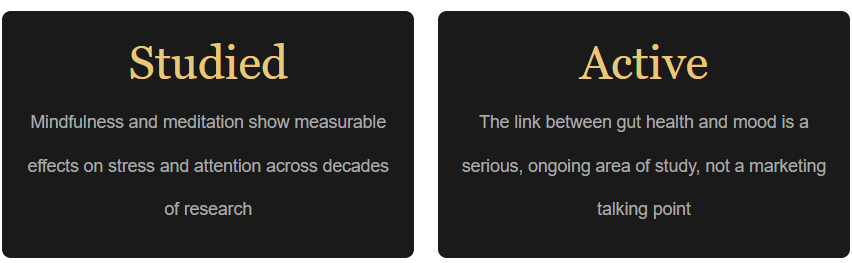
The honest takeaway: question the person selling you something, not the idea that your body is one connected system. Those are two very different things, and treating them as the same one is how good ideas get thrown out along with bad marketing.
WHAT TO ACTUALLY DO
Pick one. Run it for a week.
You don’t need to restructure your life to start. Pick one of these and run it for seven days.
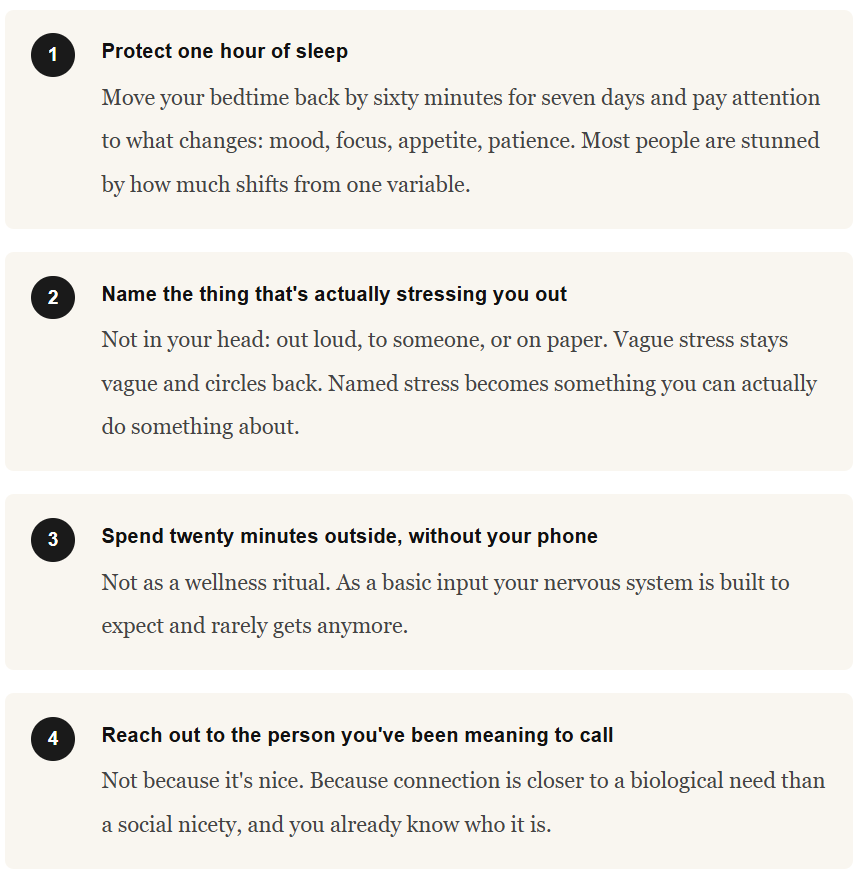
None of these will fix everything. That was never the promise. What they will do is start to show you which parts of your life are quietly running the show, the parts most of us never think to look at until something forces us to.
The actual point
The next time something feels off, before reaching for the thing that makes the feeling go away, try asking one question first: what is this connected to? Not in a mystical sense. In a literal, practical, “my body runs one system, not five” sense.
You might find the headache was never really about your head.