

Quiet the strings you're not playing, with the heel of your picking hand
A two-second palm habit kills every string you're not playing, without touching the ones you are.
This Week’s Focus
Record yourself playing a riff on the low strings and listen back with headphones. There’s a good chance you’ll hear strings ringing that you never meant to play: the open high E buzzing under a power chord, the A string humming along under a lick on the D string. None of that shows up when you’re standing in your room playing loud. It shows up the second you record, or the second you play through a clean amp, or the second the rest of the band drops out and it’s just you.
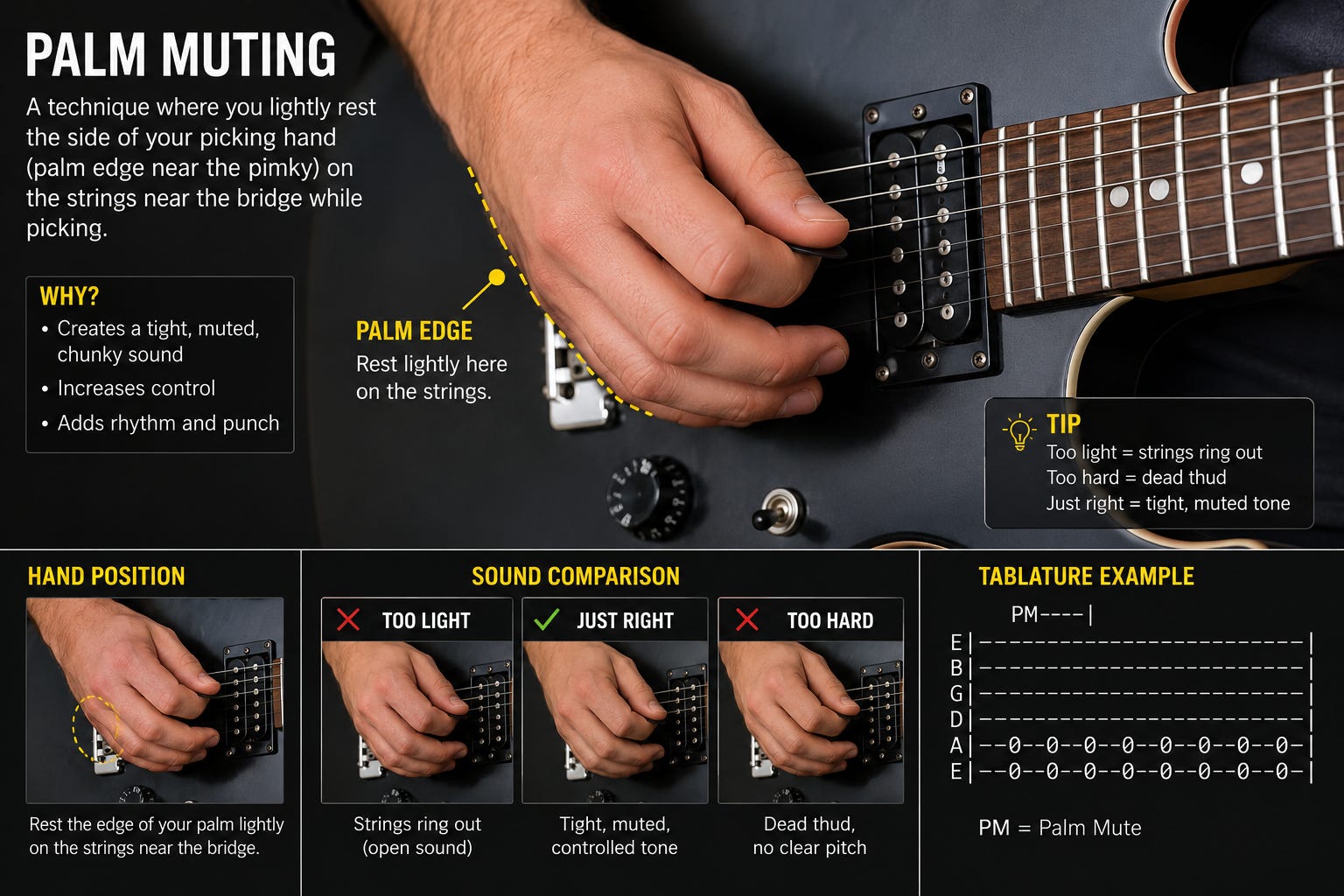
That noise isn’t a gear problem and it isn’t a fretting-hand problem. It’s a picking-hand problem, and the fix is one of the simplest techniques in guitar: resting the edge of your picking-hand palm across the strings you aren’t using. Not the strings you’re about to mute for a chunky riff, the strings you have no intention of playing at all. Done right, your fret hand keeps moving freely while your palm quietly kills everything underneath it.
Learning objectives
By the end of this lesson, you will be able to:
Tell the difference between palm muting for tone and palm muting for silence
Find the resting spot on your palm that kills unused strings without choking the ones you’re playing
Adjust palm position as your picking hand moves across the strings
Hear the difference a muted unused string makes on a recording versus live
Build the habit into riffs, chords, and lead playing without thinking about it mid-phrase
Do this before you start
Plug into something clean. A clean amp setting or a clean DI into your phone exposes unwanted string noise far better than a distorted tone, which buries it.
Have your guitar within reach right now. This is a hand-position habit. You build it by feel, not by reading about it.
NOW LET’S GET INTO IT!
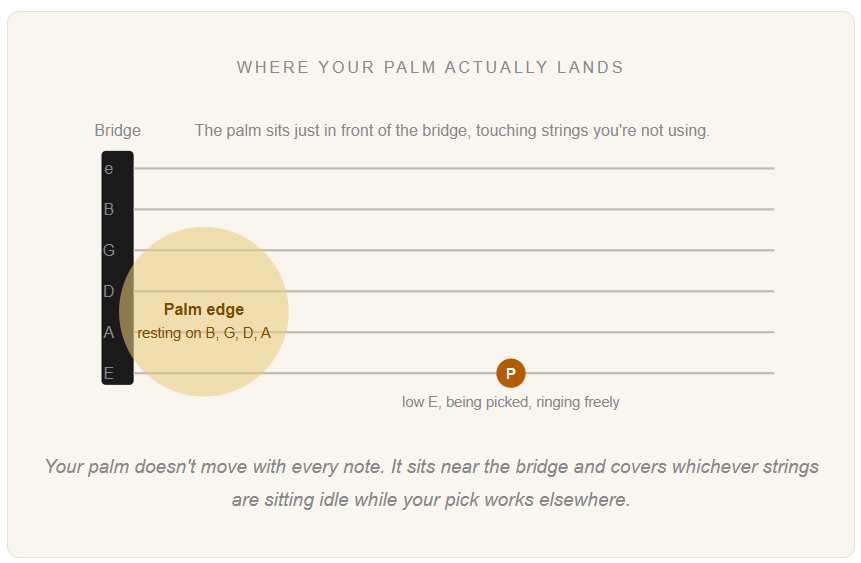
The spot that works for most players is the fleshy outer edge of the palm, right below the pinky, resting just in front of the bridge saddles. Too far back toward the middle of the strings and you'll choke notes you actually want to ring. Right at the bridge, you get just enough dampening to kill an open string's vibration without smothering a note your pick is actively attacking a few inches away.
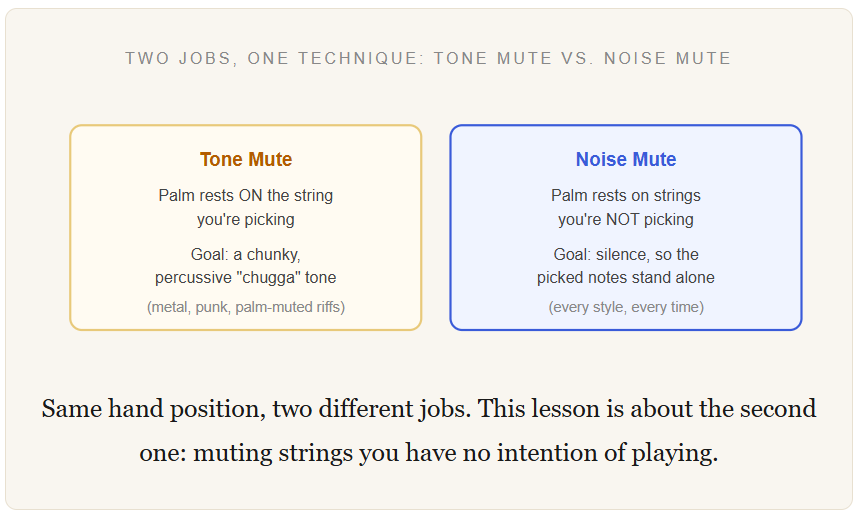
Most players learn tone muting first because it’s the one with a famous sound attached to it. Noise muting gets skipped because nobody notices it’s missing until a recording exposes the silence that should have been there. That’s exactly why it matters: it’s invisible when it’s working and obvious the moment it’s gone.
9 THINGS YOU CAN TRY THIS WEEK
1. Find the Spot With One String
Play an open low E string and let it ring. Now lay the outer edge of your palm across it near the bridge and listen to how fast it dies. Move your palm an inch toward the neck and try again. Notice how much faster it kills the note the further you are from the bridge.
2. Mute Everything, Pick Nothing
Lay your whole palm across all six strings and strum. You should hear almost nothing, just a faint percussive thud. If you’re hearing ring, your palm isn’t making full contact across every string.
3. Play a Riff on the Low E, Mute the Rest
Pick the open low E string repeatedly while resting your palm lightly across the A, D, G, B, and high E. The low E should ring clean and loud while the other five stay completely silent underneath it.
4. Move the Mute When You Move Strings
Play a lick that travels from the low E up to the D string. As your pick moves, your palm needs to shift slightly so it’s covering the strings below wherever you’ve landed, not the ones above. This is the part that takes the longest to feel automatic.
5. Test It With an Open Chord
Strum an open G chord, but only intend to ring the bottom three strings as a riff. Use your palm to kill the top three. This forces you to mute strings sitting right in the middle of your strumming pattern, not just off to one side.
6. Record Yourself Without It, Then With It
Play any riff for 30 seconds with no muting at all, then play it again resting your palm on the unused strings. Listen back on headphones. The difference is usually bigger than players expect the first time they hear it side by side.
7. Check Your Fret Hand Too
The palm handles strings near the bridge, but a fret-hand finger lightly touching an unused string higher up the neck catches noise the palm can’t reach. Use both together on wider chord shapes.
8. Apply It to String Skipping
Any time you pick a low string and a high string while skipping the ones in between, like in hybrid picking or wide-interval licks, those middle strings are exposed and ringing unless your palm is sitting across them.
9. Apply It to One Real Song
Pick a song you already play and run it through once paying attention only to which strings should be silent at each moment. Most players find at least one section where an open string has been ringing the whole time without them noticing.
HOW WORKING PLAYERS USE IT
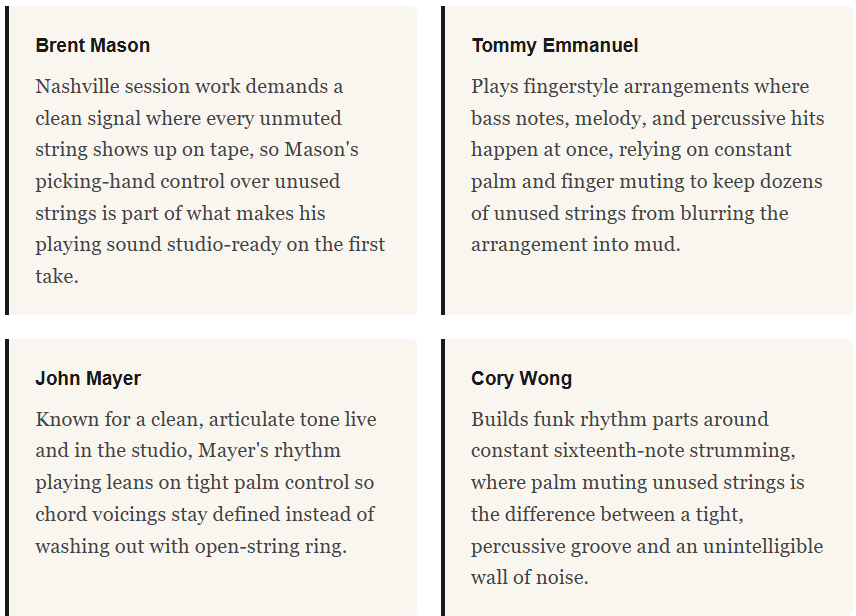
This isn’t a flashy technique, which is exactly why the players who rely on it the most rarely get asked about it. It shows up most in players whose tone has to stay clean enough that nothing can hide behind distortion.
From the Archive: Read These Next
Hybrid Picking: what the pick can’t do alone
Wide string skips expose unused strings fast. This is where palm muting earns its keep.
Alternate Picking

Most guitarists plateau around the same place. They can play the things they already know, fast, but the moment they try something new at speed, it falls apart. Nine times out of ten, the culprit is …
Session players who read charts also play clean enough that every unmuted string gets heard. The two habits go together.

Next issue: we’re breaking down economy picking, the technique that decides when alternate picking should bend its own rule to cross strings faster.
